Showing posts with label covid-19. Show all posts

Sunday, April 19, 2020

All is Well! FAANG Stocks Hit All Times High as the Economy Collapses

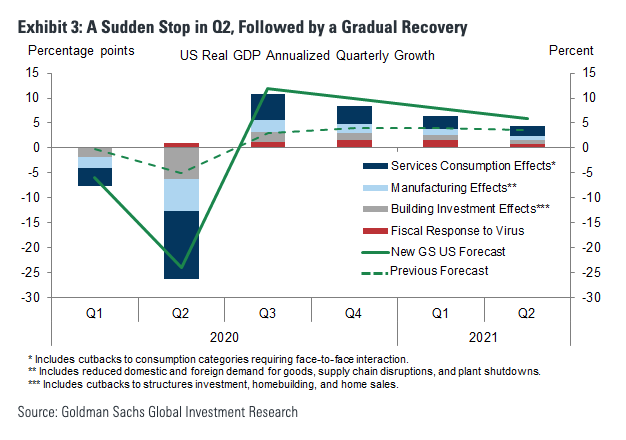
The economy is in shamble with predictions of 20%+ drop in Q2 GDP and so far 22 million people filing for unemployment in the US in the last four weeks, but the market acts as if nothing happened with the NASDAQ positive for the year.
A lot of it as to do with the various government stimulus, FED balance sheet going through the roof, as well as more demand from companies providing services for the many "work from home" (WFH) workers due to lockdowns.

But if we look into the details it's not that pretty, as FAANG stocks are responsible for most of the rise. In other words, it's not a broad market rally, and many NASDAQ stocks are still way down.

From a historical perspective, most bear markets will have a bear market rally, as shown from the S&P 500 chart below between 1998 and 2020. Source: NorthmanTrader.


You could always say "but Dark Horse, 2020 won't be like the great depression, and instead, it's just like 1987, we had the "best economy ever" and it's all up from here after everybody goes back to work + FED put!". To that argument, I'd answer the market was not overextended in 1987 as shown by the market cap to GDP ratio aka "buffer indicator".
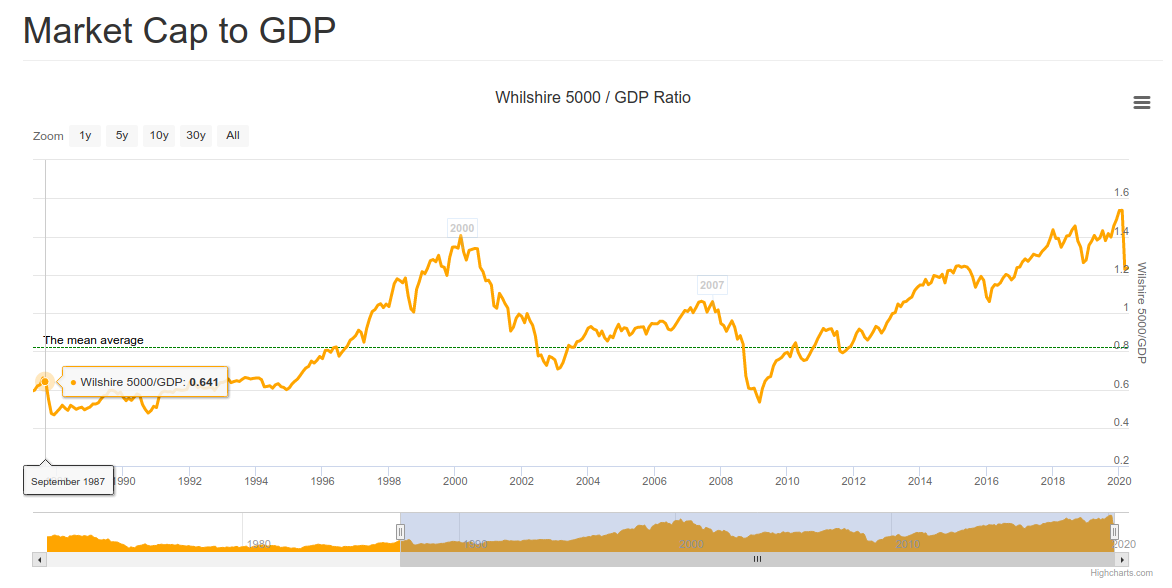
Before the crash in 1987, the market cap to GDP was just 64%, and now it's around 130% before dismissal GDP numbers are announced meaning it should be above the previous record soon.

I'm a big believer in mean reversion of things like market cap to GDP and PER ratio / CAPE ratio. We previously wrote how many markets were overvalued including the US markets, and GMO just released their quarterly update with their expectations of yearly returns for various markets over a 7-year period.

That means large US stocks may lose around 1.5% a year over the next seven years, not a nice proposition especially when considering those numbers were after the correction in March 2020. Also note bonds don't look to be a good place to hide either, but emerging value stocks have some good prospects, and we previously mentioned that Chinese commodity producers may be a place to look for investment opportunities.

I'd still stay very prudent here as there are many risks around. We are quite surprised people expect a vaccine by 12 to 18 months, as we would like to remind our readers that some virus-induced diseases don't have a vaccine, think AIDS or dengue fever. The latter is even scarier because you don't develop immunity, and instead, the risk of death is greater the second time, and even more the third time. There have been reports that released COVID-19 patients have contracted the disease again, so herd immunity is not even a given, but so far there's no indication that the second infection is nastier like for dengue fever.

Stay safe! We live in scary times for our health, finances, and freedom from governments.

Wednesday, April 1, 2020

Fraud Warning - COVID-19 Bank Scams

In February 2020, we wrote about one particular type of financial fraud, namely pre-IPO offering for well-known companies like Virgin Hyperloop One and AirBnB, where the scammer call victims offering investment opportunities.

But just like politicians, scammers never let a crisis go to waster, and we've received information from Standard Chartered Bank so some are trying to exploit COVID-19 pandemic to prey on victims.

Here's the email from the bank:


Protect your business from COVID-19 bank scams

Criminals are exploiting the COVID-19 pandemic to target and scam bank clients. They are using social engineering techniques (Phishing and Vishing) to hack or spoof business email accounts to fool potential victims into making fraudulent payments or to gain access to online banking authentication credentials for financial gain.

Please be extra vigilant and heed the following advice:

  • Do not disclose your S2B credentials, VASCO OTP or account details to anyone, as this may compromise the security of your account.
  • If you receive any suspicious emails, do not click on links or attachments until you have validated the source. Please ensure that you access your bank account only through our official channels.
  • If you receive any suspicious text messages or phone calls, do not respond directly, please verify if the message or the caller is legitimate. 
  • Validate any new bank account details directly with your suppliers / clients. If you notice unauthorised transactions appearing in your account, please report to us immediately.
Thank you for banking with us.

Sunday, March 29, 2020

How Long Will the COVID-19 Response Impact the Economy?

COVID-19 pandemic and its public policy response have caused a massive drop in economic activity. It's a given that Q1 and Q2 GDP numbers will be negative worldwide, but what can we expect going forward?

One way to look a the future is to check how China is doing to far since they were the first impacted and based on data coming from the government managed to contain SARS-CoV-2 virus by the end of February 2020.

COVID-19 Cases in China
This was achieved thanks to draconian lockdown measures, including locking persons suspected to be infected into their home. Shanghai stock market did drop by around 10 percent during Chinese New Year but quickly recovered, until it become clear COVID-19 would have a serious impact all around the world.

The PMI dropped sharply in February to 35.70 points, but we still have to wait longer to know the extent of the rebound in March and April.


Many businesses have re-opened, and while Hubei province has recently re-opened its borders (March 28), neighboring provinces are still wary of letting people travel. We also have contact in China, that non-essential business (e.g. entertainment) will not re-open until the end of April, and that's in Liaoning far from the epicenter in Wuhan. So in China, it's quite possible the local economy returns to normal in May. It would have been 4 full months since the beginning of the spread of the disease. However, China's GDP will certainly be impacted by the drop of activity in the rest of the world that is around 1.5 months behind in terms of cases.

My best-case scenario where the virus is contained around the world as fast as it was in China is that activity returns to "normal", yet somewhat lower levels, in July 2020. That would mean a sharply higher quarter-on-quarter Q3 GDP (worldwide), but still fairly lower year-on-year.

This assumes somehow few businesses and consumers bankruptcies, not currency crisis following helicopter money from central banks, or any other major financial issues related to the COVID-19 shutdown. How likely is that I'm not so sure, but this was the view of Goldman Sachs around a week ago with a 24% GDP drop in Q2 in the US, followed by +10% in Q3, and +8% in Q4 with the full year down 3.8%.


That would be a short recession, but considering how the US stock market was extended in February 2020 (and still is), problems are likely to linger much longer in the US, and many other countries.

Viruses are also interesting creatures, and earlier this month, we tried to look at the 1918-1919 Spanish flu to understand the economic and market impact of the novel Coronavirus, and we posted this chart representing the numbers of death per 100,000 in the UK at the time.

Viruses come in waves. It started in June-July 1918, then dropped until around early October, before coming back with a vengeance until the end of December with a small retrieve in January, before the last wave topping in in March 1919 before ending at the end of May 1919.

If this pattern occurred again that would be mean on and off lockdowns over a 10+ month period in each country, meaning nearly 12 months of lower economic activity worldwide, and the greatest depression we've ever seen. I have no clear idea what the world would look like in that case but there would be a low economic activity, out of control money printing, resulting in inflation down the road especially if they keep giving money directly to citizens also called MMT (Modern Monetary Theory) leading to the inflationary depression touted by Peter Schiff, at least in the US and the western world.

How will it exactly pan out? We just don't know, nor does anybody and only time will tell, but everybody should be aware of the risks and prepare at best as they can.

Sunday, March 22, 2020

2020: The Great Depression of 1929 All Over Again?

Following the governments' responses to the threat posed by COVID-19, stock markets around the world have collapsed rapidly and entered bear markets. How does the 3-week drop compare to historical events in 1929 and 1987? Here's how
Source: ZeroHedge

As of March 20, the drop is faster and deeper than for the first 40 days of the crash of 1929, and faster, but not quite as bad (yet) that the crash of 1987. The October 1987 crash was a one-time event that did not affect the economy that much, but analysts expect some serious repercussions in the real economy with expectations of a 24% GDP contraction in the US and up to 12% worldwide in Q2 2020,

That's worse than the great depression, so we may expect similar results, especially we also started with an overvalued stock market. There's one important difference though: the policy response is now much different with central banks and government throwing money around like there's no tomorrow. This will likely not prevent deflation in the short term, but a long period of deflation is unlikely. With that out of the way, let's have a look at the chart of the Dow Jones index during 1929 and 1932 courtesy of MacroTrends.


I've marked the tops and bottom with respectively green and red dots. Bear in mind, this is a monthly chart so the data represents the end of month value, not the absolute tops or bottoms. The Dow Jones topped at 5686.69 in August 1929 before falling to 3572.79 points in November 1929, or a 37% drop in 3 months. It was followed by a bear market rally that topped at 4379.05 in March 1930, a 22.5% increase. Then the market "slowly" collapsed to 814.82 over the course of 2 years a massive collapse of around 82%. If counted from the top of 1929, the stock market dropped by 85.6%.

While I don't believe the exact same scenario will happen, let's see how low the Dow Jones would have to fall to match the same pattern as in 1929.

The Dow Jones reached a top of 29,551.42 in February 2020. A 37% drop over three months would mean a Dow Jones valued at around 18,600 in May 2020. We are almost there though after a little over three weeks with 19,173.98 points. So we may not have to wait that long for a dead cat bounce. With a percentage gain of 22.5% that would bring us to around 22,800 points in the next three to four months or May/June considering a rebound starting as early as March. Under our scenario, it may stay at this level for a while, and then for whatever reason (second wave of COVID-19?) collapse to depression levels by May/June 2022: That would be 4,104 points, even lower than the market low of 6,469.95 reached on March 6, 2009. Put it that way it does not seem as impossible. Is it likely? Maybe not, as it would mean all that money created out of thin air would go in other assets than the stock market. Charles Nenner has been forecasting a market bottom at 5,000 points based on his work on cycles so it's not so far off.

So I've created a virtual chart of the Dow Jones with the data points above, and a slightly compressed schedule with the bottoming occurring in December 2021.
Dow Jones Simulation - Jan 2020 - Dec 2021

 It's not a prediction, just a simulation of what the next two years would look like if the Global Great Depression of 2020 had indeed started, and would take a path similar to the great depression of 1929. Hopefully, it's all wrong. Note that during market bottoms, the Gold price historically happens to match the Dow Jones price, so it would be at over $4,000 per ounce in our scenario.