Showing posts with label china. Show all posts

Sunday, August 23, 2020

GMO Forecast July 2020 - Emerging Value is the Only Game in Town

 GMO published their latest 7-year forecast for July 2020, and most asset classes have dismissal expected returns over the next seven years from US large stocks to emerging stocks and large and small international stocks. Let's not even get started with bonds that are just as bad.

While we would consider gold, silver and other so-called real assets to be a potentially good long term investments at this point in time, those are not tracked by GMO, but we've noticed one exception in GMO chart: Emerging value.

9.2% yearly returns over seven would be an excellent investment in those days and age, but as we can see GMO separates emerging and emerging value, so we can't just buy any emerging stocks trackers.

But what's a value stock exactly? Here's Investopedia definition:

A value stock is a security trading at a lower price than what the company’s performance may otherwise indicate. Investors in value stocks attempt to capitalize on inefficiencies in the market, since the price of the underlying equity may not match the company’s performance.

They are often opposed to Growth stocks, often referring to stocks in the Technology and Biotechnology sectors with very high P/E ratios.

 Investopedia main takeaways:

  • Common characteristics of value stocks include high dividend yield, low P/B ratio and/or a low P/E ratio.
  • A value stock typically has a bargain-price as investors see the company as unfavorable in the marketplace.
  • A value stock typically has an equity price lower than stock prices of companies in the same industry.

So value stocks may be dividend stocks with low price-to-book and low price-earning ratio. This includes utilities, banks, consumer staples, and some commodities producers.

So our best bet would be to find value stocks in undervalued emerging markets, which last time we looked included Russia, China, Turkey, Hungary, and South Korea. With Russia, it's easy as most stocks are value stocks, and we could just add a Russia ETF to our portfolio such as MSCI Russia Capped Index (3027.HK) in Hong Kong and VANECK VECTORS/RUSSIA ETF (RSX) in the US.

China is more complex since the stock indexes include highly priced technology company such as Tencent, Allibaba and Baidu. One such option is Value China ETF (3046.HK) whose top holdings include Chinese banks, real-estate companies and insurances.

All companies are listed in the Hong Kong stock market. Alternatively, there's also Value China A-Share ETF (3095 HK) with companies listed in China, and more of a Chinese consumers story with 35% Consumer Goods, 34% Financials.

Note that while Google Finance shows there's no dividend paid out, you'd get ~2% dividend paid out yearly.

I had more of a struggle finding a China value stock in North America, and one of the closest would be Horizons China High Dividend Yield Index ETF (HCN.TO) listed in Canada.

The funds distributed dividends every quarter. The current is 6.77% based on info from Yahoo Finance.

I will not look into Turkey due to geopolitical risks at the moment, nor the smaller Hungary market, and complete this post by checking out South Korea. If you want to invest in South Korea, there's limited choice when it comes to South Korea ETF, and most people will not be able to purchase stocks on the KOSPI exchange.

That means we'd have to accept getting some experience to technology stocks like Samsung Electronics (PE: 17.49, DY: 2.53%), Naver (PE: 64.40, DY: 0.12%),  or  SKHynix (PE:22.3, DY: 1.34%) through South Kora ETF such as iShares MSCI South Korea Index Fund (EWI). 


In any case, I'm uncomfortable purchasing stocks in the September-October months due to the high-valuation in the US stock market, and a stock market sell off in the US, may lead to a rise in the US dollars, and a sharp drop in emerging stock markets. If it does happen, it will certainly be an interesting buying opportunity. 


Sunday, March 29, 2020

How Long Will the COVID-19 Response Impact the Economy?

COVID-19 pandemic and its public policy response have caused a massive drop in economic activity. It's a given that Q1 and Q2 GDP numbers will be negative worldwide, but what can we expect going forward?

One way to look a the future is to check how China is doing to far since they were the first impacted and based on data coming from the government managed to contain SARS-CoV-2 virus by the end of February 2020.

COVID-19 Cases in China
This was achieved thanks to draconian lockdown measures, including locking persons suspected to be infected into their home. Shanghai stock market did drop by around 10 percent during Chinese New Year but quickly recovered, until it become clear COVID-19 would have a serious impact all around the world.

The PMI dropped sharply in February to 35.70 points, but we still have to wait longer to know the extent of the rebound in March and April.


Many businesses have re-opened, and while Hubei province has recently re-opened its borders (March 28), neighboring provinces are still wary of letting people travel. We also have contact in China, that non-essential business (e.g. entertainment) will not re-open until the end of April, and that's in Liaoning far from the epicenter in Wuhan. So in China, it's quite possible the local economy returns to normal in May. It would have been 4 full months since the beginning of the spread of the disease. However, China's GDP will certainly be impacted by the drop of activity in the rest of the world that is around 1.5 months behind in terms of cases.

My best-case scenario where the virus is contained around the world as fast as it was in China is that activity returns to "normal", yet somewhat lower levels, in July 2020. That would mean a sharply higher quarter-on-quarter Q3 GDP (worldwide), but still fairly lower year-on-year.

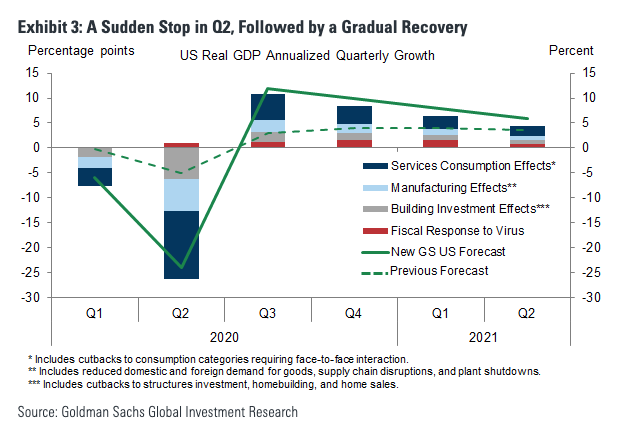
This assumes somehow few businesses and consumers bankruptcies, not currency crisis following helicopter money from central banks, or any other major financial issues related to the COVID-19 shutdown. How likely is that I'm not so sure, but this was the view of Goldman Sachs around a week ago with a 24% GDP drop in Q2 in the US, followed by +10% in Q3, and +8% in Q4 with the full year down 3.8%.


That would be a short recession, but considering how the US stock market was extended in February 2020 (and still is), problems are likely to linger much longer in the US, and many other countries.

Viruses are also interesting creatures, and earlier this month, we tried to look at the 1918-1919 Spanish flu to understand the economic and market impact of the novel Coronavirus, and we posted this chart representing the numbers of death per 100,000 in the UK at the time.

Viruses come in waves. It started in June-July 1918, then dropped until around early October, before coming back with a vengeance until the end of December with a small retrieve in January, before the last wave topping in in March 1919 before ending at the end of May 1919.

If this pattern occurred again that would be mean on and off lockdowns over a 10+ month period in each country, meaning nearly 12 months of lower economic activity worldwide, and the greatest depression we've ever seen. I have no clear idea what the world would look like in that case but there would be a low economic activity, out of control money printing, resulting in inflation down the road especially if they keep giving money directly to citizens also called MMT (Modern Monetary Theory) leading to the inflationary depression touted by Peter Schiff, at least in the US and the western world.

How will it exactly pan out? We just don't know, nor does anybody and only time will tell, but everybody should be aware of the risks and prepare at best as they can.

Saturday, March 7, 2020

Undervalued Markets in March 2020 - Top 10 Countries

Value and contrarian investors will always look for undervalued and unloved markets or stocks, and one tool I like to use to find out which market may be worth looking into is Starcapital stock market valuation that ranks different countries based on their CAPE (Cost Adjusted Price Earning Ratio), average dividend yield, price-to-book ratio, and price-to-sales-ratio. They also show RS26 (26-weeks relative strength) and RS52 ratio to show which markets were oversold or overbought in respectively the last 6 months and the last year.

This is what the map looks like on February 28, 2020 with countries in blue being undervalued, and the ones in red being overvalued using CAPE as reference.


Russia, Turkey, Poland, Oman looks to be quite undervalued using this metric, while the US, Ireland, Switzerland, New Zeland, and Finland are overvalued.

Here's the top ten list of the most undervalued markets as of March 2020.


That's Russia, China, Italy, Spain, Singapore, Turkey, Austria, South Korea, Portugal, and Hungary.

Starcapital does not use the CAPE as the only metric to rank to the country with average PC (Price-to-cashflow), PB (Price-to-book), and PS (Price-to-sales) ratios. To find out if the CAPE is undervalued, one needs to look at the long term ratio for each country, and the ratio can not be compared between countries because each stock market has different types of companies. For example, Russia will have a large share of companies related to the oil business which command a lower price-earning ratio. Sadly, the company does not provide its historical data, so I'll just trust its color scheme for that part.

If the price-to-book ratio is lower than one, that means the stock price is cheaper than the book value, and it's always a good metric to check you don't overpay for a stock or market. If the dividend yield is fairly high, that's often a sign, stocks are undervalued as well.

I view the relative strength index more as a timing tool, as it shows whether the stocks for a given country were sold or bought during the time period. Starcapital allows to filter results as well, and I often set PB to one or lower, and RS26 to a value under one (e.g. 0.94).


That leaves us with 5 countries: Russia, Singapore, Austria, South Korea, and Poland. The next step is to look at mid-term charts (e.g. 10 years) to see how stocks performed. I like to use trading economics.


The Russian stock market did very well in the last 6 years, and we did buy a Russian ETF (3027.HK) in 2014-2015, and sold in October/November 2019. It went up further since then, but a correction happened due to the Coronavirus panic. If the market corrects further it could be a nice entry point.


The Singapore stock market (STI) has been trading in the 2600-3500 range in the last ten years, so if it goes back to 2700 points it may be an interesting entry point. Looking at an even longer-term chart, we can see the market performed fairly well since 2002, but as a smaller country, it may suffer more in downturns.

Next up is the Austria stock market (ATX), which we can see went down for over 2 years.
Looking at the chart since 2001, we can see the ATX never covered in a big way from the GFC (Global Financial Crisis) in 2008.
It's almost 50% below its all-time high in 2017..., and if we look at the long term bottom trend we could go a line showing there may be opportunities right now. I still feel uneasy investing in Europe due to structural issues with the Euros though.


The 10-year chart of the KOSPI (South Korean stock market) shows the index did not return much over the last ten years, and long term bull markets are often born from a long bottoming process.

To balance that, the KOSPI did really well in the first decade of this century, quadrupling from 500 points to over 200 points in 2007, but 13 years later we are still at the same point. It's been a long wait for investors who are still getting a 2.3% dividend yield at this time.

Let's finish with the Polish stock market (WIG). The last two years have been brutal which should explain why it's now considered an undervalued stock market.
It seems to be at the bottom of the trends (using a line passing through 2012 and 2016 bottoms), but the 20-year chart shows again the great performance of emerging markets in the 2000's.
Yet the WIG is still well below its all-time high in 2017. All those five markets look interesting, in the short term are likely to be affected by the impact of the Coronavirus outbreak, the policy decisions of central banks and government around the world, and potentially the health of the US stock market which looks to be extended at this time, but we'll look into the later in a subsequent post

Sunday, February 23, 2020

The Case for Investing in Chinese Commodity Producers

Many asset classes around the world are overvalued right now, but I recently watched a video with Mike Maloney and Ronald-Peter Stöferle (of Incrementum AG) with the latter showing a chart we may be back to 2000 valuations for commodities.


The chart above represents the ratio between the SPGSCITR commodity index (aka S&P GSCI) against the S&P 500. It just shows stocks are really expensive compared to commodities.

And if we look at the long term chart of the GSCI commodity index courtesy of trading economics, commodities are indeed back to price not seen since the end of the 90's.

Great! Let's find a GSCI ETF tracker and we should get a nice return you may think. But not so fast, as you may remember commodity ETFs are usually terrible investments due to the contango effect. But let's double-check as in the US, there are two ETF's tracking GSCI: GSP and GSG.


Those are down around 70% since May 2016. The GSCI index is also down since that time, but only about 60%, It's not that bad considering the ~15 years time frame.

However, my brokers won't let me invest directly in ETF's in the US. So instead, I looked at mining stocks like BHP and Rio Tinto listed in the US.


While both stocks are well below their peals in 2006 or 2011, they have recovered a lot since the bottom in early 2016.

So I went looking for other opportunities in the Hong Kong stock market (Hang Seng). There aren't any commodity ETFs anymore apart from Gold based ones. So we can look at the charts, earnings, dividends and P/E of some of the commodity producers. It's always more risky to selecting individual stocks, especially those depressed, as they may go bankrupt, so I personally prefer to focus on larger companies.

Petrochina 0857.HK

We are back to the year 2014 price. The company is still making profits (0.33 HKD EPS), and paid a 4.6% dividend last September. With a one trillion market capitalization, it's one of the biggest companies in the world. There may be more downside, but patient investors will be rewarded by the dividend and potentially higher price in a few years.

Sinopec Shanghai Petrochemical Company Limited (0338.HK)


Sinopec is another large Chinese oil company back to 2014's prices. The dividend yield stands at 13.49% according to Yahoo (I suppose this will be revised down), and the company is still making a healthy 0.561 HKD profit per share. Market capitalization: 37.30 billion HKD.

China Coal Energy Company Limited (1898.HK)


Still a large (57 billion HKD) profitable (0.387 HKD per share) company, but probably more risky if the Chinese government really decides to scale down on coal-powered power plants. The company also pays a 3.28% dividend. The share price is really depressed well under the IPO price in 2006.

Sinofert Holdings Limited (0297.HK)

If you believe in the long term potential of agriculture, Sinofert looks promising. The company specializes in Potash which shot up in 2007/2008, and came down hard since then. The stock is really depressed at 0.80 HKD. But Sinofert is one of the largest fertilizer producers in China, is still making money (.075 HKD per share), and pays a dividend of 2.8%. The same could have been said in 2012 however, but the longer the undervaluation remains, the more the stock may gain when the market reassesses.

All those companies also have a price-to-book and price-to-sales well below 1, and they are very unlikely to go bankrupt. In the worst-case scenario, the stock price goes nowhere, but you still get paid to wait thanks to the dividend.

Do you know of any other HK listed commodity stocks that are paying dividends, depressed, and profitable? Let us know in the comments.


Monday, January 21, 2013

Long Term Charts Thai Stock Market - January 2013 Update

This is a repost of the article found on CNX Translation forums.

6 months have gone since our last update, and its time again to update the long term charts of the Thai stock market.

The first chart is the SET index between 1975 and January 2013. Following other indices around the world, and despite my overvaluation view 6 months ago, the Thai stock market has continued its (unstoppable) rise in the last 6 months, and now stands at about 1440, a rise of about 40% since I started to become cautious.

Image

The PER is now around 18, mainly due to the stock market improvement. At 15, I started to be bearish, so at 18 it's extremely unusual for the Thai stock market. So either earnings have to go up substantially, either the stock market has to plunge, or a combination of the two.
Image

The price to book value slowly crept up to 2.4 which also starts to make Thai stocks overvalued, especially compared to what you get in other markets around the world. (European stocks have a P/B ratio around 1 now)
Image

To conclude, I believe the Thai stock market is relatively overvalued both historically, and compared to other stocks markets around the world. The dividend yield is now around 3% which is is that more than can get in a fixed deposit (Bangkok Bank now offers up to 2.65 % p.a for a 36 months fixed deposit), so why take the risk? There is also a lot of optimism around the world, which IMHO is not warranted, so I would not be surprised to see a massive correction in the Thai stock market within the next year.

Saturday, December 1, 2012

Marc Faber December 2012 Market Commentary

Marc Faber has just released his December 2012 market commentary "Always try to be a little kinder than Necessary" on gloomboomdoom.com.

This month report explains that something is clearly not quite right with the economy, as the recent performance of Wal-Mart, Tiffany, Genesco, and Kohl’s show. What concerns Marc Faber greatly is that most asset markets had outsized gains since early 2009, excluding Vietnamese, Chinese, Japanese, and European equities, as well as US housing. He believes that investors’ expectations about future returns are far too optimistic, and that in a world that currently hardly grows, investors will need to reduce their future return expectations. Therefore, 2013 will most probably not be a good year for holders of assets, and he has now shifted to the preservation of the outsized gains he has achieved over the last 3 years.

Marc Faber also wishes Merry Xmas to everybody and reminds his readers to try to be as nice and kind to other people quoting Albert Schweitzer: "Constant kindness can accomplish much. As the sun makes ice melt, kindness causes misunderstanding, mistrust, and hostility to evaporate." 

The monthly market commentary including one attachment:
  • The Fed’s Last Hope by Michael A. Gayed,Chief Investment Strategist at Pension Partners, LLC.
I cannot find the attachment, but Gayed mentions it in a marketwatch.com articles, and explains bonds have now very little value, and the relative advantage of dividend yields over bonds yields, will be bullish for stocks.

If you want to access the full Monthly Market Commentary (MMC) by Marc Faber, it is available for 300 USD per year.

Wednesday, November 21, 2012

GMO 7-Year Asset Class Forecasts - October 2012

GMO has released its monthly 7-year Asset Class Forecasts and since many markets have been pretty stable all year, the story remains more or less the same:

  • US Large caps: 0.3% per year
  • US Small caps: -0.2% per year
  • US High Quality: 4.8% per year
  • International Large caps: 4.8% per year
  • International Small caps: 4.2% per year
  • Emerging Markets: 6.3% per year
Avoid US stocks, except high quality, and emerging market stocks should offer the best returns. Obviously, all emerging markets are not created equal. The Chinese stock market which is very depressed is likely to return more than the Thai and Indonesian stock market for example, which seem really resilient at the moment with relatively high valuations.Most bonds, excluding Emerging debt, are still a terrible investment for the next few years according to GMO methology.

You can receive GMO's forecasts (monthly) and the quarterly newsletter for free by registering at http://www.gmo.com

Thursday, November 15, 2012

GEAB 69: Katrina-Sandy : From one Storm to the Other, the End of America as we Knew it

Here are the highlights of GEAB 69 (Novenber 2012) entitled "Katrina-Sandy : From one Storm to the Other, the End of America as we Knew it":
  • Katrina-Sandy : From one Storm to the Other, the End of America as we Knew it - The LEAP team has a controversial view that says Sandy, a small storm that has put New York to its knees, has shown that America has greatly weakened, and that it's the country we once knew anymore. In this section they also address the political division of the US and its dire financial & economic situation.
  • 2013, the king is naked: The great geopolitical dislocation of America. - The US economy is slowly but surely weakening, and 2013 will be the year of the real crisis where the "dollar wall" will collapse.
  • China 2013 : The global riot laboratory - A view of riots in China, and their consequences.
  • A Canadian Tragedy – The Slump of its Real Estate Market - Contrary to the view of Canadian banks who see a market stabilization, LEAP believe the recent slumps in Toronto and Vancouver announced the popping of the Canadian real estate bubble.
  • Strategic and operational recommendations. Currencies may remain irrational for a little longer, it's not to late to escape from the stock market, get physical Gold and do not play short term trades, energy commodities are better for the long term, but may suffer in the short term, and it's really not a good time to invest in Canadian real estate..
  • The GlobalEurometre - Results & Analyses. Only 65% of respondents expect the dollar to go down, which is the lowest figure since the survey started.
The full GEAB 69 report (PDF format) is available to LEAP 2020 subscribers for 200 Euros per year for 10 new issues + the 6 issues published before registration.

Thursday, August 2, 2012

Marc Faber August 2012 Market Commentary

Marc Faber has just published the August 2012 market commentary on the gloomboomdoom.com website.

This month report is entitled "False Knowledge; it is more Dangerous than Ignorance." where he discusses the debate between the China “bulls” and the China “bears” with the China bulls accusing the China bears of ignorance. But a close analysis of the Chinese economy reveals a meaningful economic slowdown, which is likely to have a negative impact on growth in the region since most Asian countries have larger exports to China than to Europe or the US. Markets have become complex. Few stocks are still breaking out on the upside and a large number of stocks are breaking down. Caution is advised.

There are two attachments to this monthly market commentary (MMC):
  • "Market update July 2012" by Brett Heath of KSIR Capital 
  • A report about Oslo Bors a deep value stock, by Dov Plitman and Boris Zhilin at Armor Capital.
If you want to receive the Monthly Market Commentary (MMC) by Marc Faber, it is available for 300 USD per year. 

Thursday, July 26, 2012

Marc Faber - Coming Next: Global Crash and U.S. Treasury Bubble Popping

Marc Faber is interviewed on Capital Account (Russia Today) by Lauren Lyster, where the talks about his views on US treasuries and capital markets, the Chinese economy and the consequences of a Chinese slowdown.


First, he explains that since 1981 were the yield was above 15%, US treasury have been in a bull market and is in bubble territory. But as with the Nasdaq in 1999, a bubble can continue inflation, and some friends of Marc Faber think 10 years trasuries will eventually yield less than 1%, and 30 years less than 2%. But his own view is that if yields increase again in markets such as the US and Japan, money will flow into equities, so he's not really worried if stock markets go down, even though he does not rule out a crash.

When asked about China, he basically says that Chinese government numbers are bogus, and when you look at Taiwan and South Korea, you'll find their exports to China are flat, and electricity consumption in China also show a weak picture of the Chinese economy.

Finally, he gives his outlook on what is happening now, and explains there is clearly a recession in Europe, the US is slowing down, but a China slowdown would be more important to the global economy, because it would have a strong impact on emerging economies. Currently Asia is certainly not in recession, but there is basically no growth.

Marc Faber appears in the first 10 minutes below, and the second part is about Libor with a zero hedge contributor.

Tuesday, July 17, 2012

Marc Faber: China is Weak, Don't Short Commodities and Buy Europe

Marc faber is interviewed on CNBC on the 15th of July to discuss the (fake) Chinese GDP number and his outlook on commodities and stocks

His view is that China economy is much weaker than  expected, and there should be some stimulus. He would not short Copper, because it can be easily manipulated, and rally in commodities could be in the making.

He sees good investment opportunities in Europe in countries such as Spain, Portugal and France.

Monday, May 28, 2012

Marc Faber: Global Recession in Q4/2012 Q1/2013

Marc Faber is interviewed on CNBC on the 25th of May 2012.

He explains that the best solution would be for a Greek exit, but what's likely to happen is a softening of the German position and the start of Euro-bonds which would be negative for the Euro. However, currently the Euro and the stock markets are oversold and we should anticipate a counter trend rally.

He also mentioned that as everybody focuses on Europe, the real threat to the economy could be the slowdown in India and China.

Some analysts estimate that a Greek exit could lead to a 50% correction in European stocks, but Marc Faber disagrees and views this as a good outcome likely to be positive for stocks.

He then goes into technical analysis and explains that many stocks are breaking and we should except a significant recession, so significant that he's 100% sure there will be a global recession by Q4 2012/Q1 2014 and recommends to hide in US dollars.

Friday, April 27, 2012

Eric Sprott: When (Gold) Fundamentals No Longer Apply, Review the Fundamentals

Sprott Asset Management published their monthly newsletter Market at Glance (April 2012) entitled "When Fundamentals No Longer Apply, Review the Fundamentals".

Eric Sprott and David Baker explain they still don't see a recovery:
  • US housing situation is still a bust with both existing and new home sales well below the highs reached in 2006.
  • Unemployment is still high, and despite all the news cheer-leading, the most recent numbers show week data. and the same is true for jobless claims numbers.
  • US tax receipts are only up 2% over a year (lower than inflation at 2.7%)
  • ECRI Weekly Leading Indicator (WLI) has started to trend down again in April
  • US Durable Goods Orders have dropped 4.2% in March, representing the largest decline since January 2009.
  • China's most recent Purchasing Managers Index (PMI) indicates that China's manufacturing activity has now been in contraction for six months in a row.
  • The situation in Europe continues to worsen: Spain is a complete disaster, Italy prospects do not look good either, and German PMI shows a decline in economic activity with the fastest rate of contraction since July 2009.
All those bad numbers guarantee that central banks will print money again, and the IMF most recently secured $430 billion worth of new "pledges" from various G20 member countries to increase its potential lending capacity to $700 billion in the event of further problems in the Eurozone. BRIC countries are irritated by these actions and their lack of voting power in this institution.

Possibly to counter this issue, BRICs have planned to start their own financial institution at the last BRIC summit and reports seem to indicate a BRICS central bank - an institution that could facilitate their ability to "do more business with each other in their local currencies, to help insulate from U.S. dollar fluctuations" might be created.

China has also been importing a lot of Gold via Hong Kong recently. In February, China imported 40 tons of Gold via Hong Kong, 13 times more compared to the same month last year and other emerging countries also follow suite, with 12 countries increasing their Gold reserves by more than 58 tons in March (that's 696 tons annualized). There is so much Gold bought by central banks, that Merk and Baker wonder where they'll find that Gold for delivery.

Eric Sprott concludes as follows:

We have written at length about the disconnect between the paper gold price and the physical gold market. If the demand changes stated above applied to any other market, the investing public would lose their minds. Could you imagine, for example, if the demand shifts described above were applied to the global oil market? What would happen if a single country came in from nowhere and increased its oil purchases by a factor equivalent to 30% of the world's annual oil supply? We are students first and foremost of the physical market, and the numbers stated above speak for themselves. We remain confident about gold for the simple reason that the demand we are now seeing for physical is completely unsustainable without higher prices, and we do not see that demand abating in the coming months. The US recovery is not happening. Europe is poised for yet another full-fledged economic crisis, and the BRICS countries continue to aggressively convert to hard assets like gold in order to protect themselves from currency debasement. The paper market for gold can continue its charade, but demand in the physical market will soon overpower it through sheer momentum - there's only so much physical to go around, and it appears that there are some very large buyers that are eager to take it.
The full version of the newsletter is available at  http://sprott.com/markets-at-a-glance/when-fundamentals-no-longer-apply,-review-the-fundamentals/

Monday, April 9, 2012

Jim Rogers: How to Invest in the Agriculture Sector in China

Jim Rogers is interviewed by China Daily on the 9th of April 2012 where he gives a few investment ideas for the Agriculture sector in China from becoming a farmer to owning commodity futures.

Friday, March 23, 2012

Jim Rogers: Buy Chinese Shares & Gold on Pullbacks

American investor Jim Rogers in Madrid (Spain)...

Jim Rogers interview on CNBC Fast Money on the 23rd of March 2012.

He said he hoped that the Chinese market collapses so he can buy (more) Chinese shares and sees a global slowdown within 1 or 2 years. He also said the would buy more and more Gold as the price falls. He would buy Gold very aggressively would it fall to the 1200-1300 USD range. He's also short US treasuries even if he admits it has not worked so well to date.

Saturday, March 17, 2012

Jim Grant: How About Capitalism, Ben Bernanke ?

James Grant is interviewed on Bloomberg and the 13th of March 2012 after the federal reserve meeting.

He first talks about the Federal Reserve monetary policy and the bond market.

He explains that by distorting interest rates, the Federal reserve has suppressed price mechanisms and with little value in bonds (he calls the bond market a "desert of value"), many people flock to high yielding junk bonds.

JACKSONVILLE, FL - NOVEMBER 5:  Federal Reserv...
Ben Bernanke
He also "translates" terms of Bernanke speech:
  • Highly accomodative = high manipulative
  • Quantitative easing = money printing
He explains that Gold price is a function of the action of central banks and note that the ECB has increased its balance sheet by an astounding 89% on an annual basis, the British central bank by 67% and the fed by only 15%. All those numbers are unprecedented and the way they do it is by simply taping numbers on a computer screen.

Jim Grant also took a stab at Warrent Buffet's "Stocks outperform Gold" by showing a chart between 1996 and today with the prices of Gold, sugar and Coca-Cola stock. During that period Gold was the best performer, followed by sugar and then Coca-cola. He explains that valuation is important. Whereas Coca-cola had a PE ratio of 39 in 1996, it now has a much better 16 PE ratio. He also mentioned that while Gold is now the refuge of the fearful, back in 1996, Gold was considered to be the refuge of the idiots. :)

Finally he says he's bearish on the Chinese economy and worries about the consequence of a Chinese slump, since many people think the Chinese have found the formula to make it work...

Thursday, March 15, 2012

GEAB 63: Global Systemic Crisis: The 5 Devastating Storms of Summer 2012 at the Heart of the Global Geopolitical Dislocation

Here are the highlights of GEAB 63 (March 2012) entitled "Global Systemic Crisis: The 5 devastating storms of summer 2012 at the heart of global geopolitical dislocation":
  • Global Systemic Crisis: The five devastating storms of summer 2012 at the heart of the global geopolitical dislocation.  Global recession, debt crises, stock market crashes, potential war with Iran.
  • Summer 2012: The US falls back into recession as Europe stagnates and BRICs slow down. LEAP 2012 predicts a global recession in 2012.
  • Summer 2012: Central banks roadblocks and the rise of interest rates. The US federal reserve must now manage two new problems: the lack of demand for US treasuries and the rise of two other currencies: the Euro and the Chinese yuan.
  • Summer 2012: Storm on currency markets and western public debts. After several attempts to stabilize exchange rates over the last few quarters, the failure to come to an agreement for a new currency at the G20 in order to build a new monetary system will lead to more currency volatility and further debt crises in western economies.
  • Summer 2012: Iran, the war "too many". Whether this war occurs or not, it will be the war too many for the western world.
  • Summer 2012: The new stock market and financial institutions crash. Iran's allies, such as China, are likely to hurt Washington financially by diversifying US dollar assets into other currencies.by announcing with Moscow that they will stop buying US treasuries in order to stop the US war machine.
  • 2015: "The great fall of western real estate" - Excerpt of the chapter on the evolution of US residential real estate. As the US manufactures less and less, the country will become poorer and accelerated the fall of American real estate.
  • Strategic and operational recommendations. Consequence of the emergence of 3 main monetary zones (US Europe and China). Inflection point for Gold. Commodities: conflict vs recession. End of the illusion for the US economy. Orange alert (whatever that means) on financial products..
  • The GlobalEurometre - Results & Analyses. 85% of respondents think of European governance is being put into place.
The full GEAB 63 (PDF format) is available to LEAP 2020 subscribers for 200 Euros per year (10 + 6 issues).

Wednesday, February 29, 2012

Marc Faber March 2012 Market Commentary

LIANYUNGANG, CHINA - AUGUST 10:   A staff memb...
Image by Getty Images via @daylife
Marc Faber has just released his March 2012 market commentary on the gloomboomdoom.com website.

This month report is entitled "When we are no longer able to change a Situation, we must change ourselves", possibly referring to the massive debt load of western economies and the change of attitude required in those economies.

There is one attachment with this monthly market commentary (MMC):

  • "China's Leadership Transition - Social Stability May Require a Stronger Renminbi" by Kieran Osborne, Director of Research of Merk Investments.
In this free report, Kieran Osborne describes the current political system in China (2012 will see a new leader) and analyses different metrics of China economy (inflation rate, bonds issuance, currency swaps ...) that may impact the Chinese Yuan.

He concludes as follows:
Any marginal change in the governance of China is likely to have far reaching implications. Most notably, we expect an increased focus on developing the Chinese middle class and domestic economy over time, with less reliance on the export sector. In turn, political and economic realities are likely to force Chinese policy makers to allow the RMB to appreciate, to help manage domestic inflationary pressures, and thus maintain social stability. We consider that China has the ability to allow its currency to appreciate and put in place steps towards a free-floating framework, due to increased pricing power resulting from manufacturing of a wider range of value-added goods. Indeed, we have seen steps put in place to ready the country for appreciation of the currency, including conducting scenario analyses on local businesses, while concurrently increasing the internationalization of the currency. China is likely to become a global financial hub and a more attractive place for global business, as a bi-product of such initiatives. Such dynamics are likely to lead to ongoing strengthening in the Chinese currency over the foreseeable future.
If I can find a summary, I'll post highlights of the Gloom Boom Doom market commentary, although in recent months it has been hard to find.

Thursday, February 23, 2012

Hugh Hendry: Watch Out for Hyperdeflation

Barron's has posted the transcript of an insightful interview with Hugh Hendry, Electica  where he talks about hyperdeflation, China's potential hard landing, and his take on Japan (Companies are doomed, but the Japanese Yen could rise to 50 Yen per US Dollar). He's also very bullish on agriculture commodities and related companies. 

Here it is (emphasis mine):
Barron's: What makes a great macro fund manager?
 
Hendry: First and foremost, an ability to establish a contentious premise outside the existing belief system, and have it go on and be adopted by the rest of the financial community. My great hero is [Caxton Associates' founder] Bruce Kovner, who was able to imagine the dollar falling to 100 yen—when the rate was 200. I am an existentialist. To my mind, the three most important principles when it comes to investing are Albert Camus' principles of ethics: God is dead, life is absurd and there are no rules. Of course, that's a doctrine of promoting the individual. You own your own decisions. As CIO of Eclectica, with $700 million [under management], I have no engagement with the sell side.

Where do you find yourself outside the existing belief system today?


In 2009, I made a YouTube video of the empty skyscrapers in Wuhan, China. Goldman Sachs and others articulate a very reasonable and compelling argument of being invested in China. With the evidence of my own eyes, I concluded that China had a very robust system of creating gross-domestic-product growth, but forsaking the creation of wealth.
When America was having its China moment in the 19th century, it occurred against the backdrop of a gold standard, a hard-money regime, with a public sector that was minuscule versus the overall size of the economy. As an entrepreneur, if your project failed to generate a sustainable level of cash flow, you failed.

China's great opportunity is taking place within the U.S. fiat system, and so the consequences are perhaps less stark than in 19th-century America, which had stops and starts and many depressions, though with an overarching prosperity. China has not had that volatility.
If you talk about a hard landing in China, you talk about GDP growth of 5%, not minus 5% or minus 15%. The Chinese government prints money. It can build superfast railways and overbuild airports, because the rest of the economy can subsidize it. China's swollen public sector is directing asset allocation, rather than pursuing profit maximization. They see [their system] as a success. But it creates a bubble, which can prove quite damaging.

You've already had a hard landing—in the Chinese stock market.


I should add something else that is contentious—U.S. quantitative easing [that eventually sent more money flowing to China], promoted because America had two sharp recessions and pursued orthodox policies, and had very little to show in the creation of jobs.

The policy was very successful. China now has inflation. Minimum wages have grown 20% annually for the past three years. This has encouraged the Chinese to tighten monetary policy. When you have bubbles and you tighten, bad things happen. China's stock and property markets are weak, a side-effect of quantitative easing. We may now have the pricking of the Chinese bubble. A year or two down the line, it could have enormous repercussions for the global economy.

How does one play it?


The world is very fearful of hyperinflation. Pension schemes have a preponderance of real assets, from forestry to gold to TIPS [Treasury inflation-protected securities], because they are very fearful. The road to hyperinflation is via hyperdeflation. That is why it's proving so difficult for hedge funds to make money. How does the rational mind that anticipates hyperinflation own 10-year government Treasuries yielding less than 2%? It can't. That's why people are struggling. To lay the seeds of hyperinflation, you need really, really bad things to happen. I thought the U.S. housing market having a massive crash would be hyperdeflationary. But then my Chinese friends pumped $1 trillion of credit into their $5 trillion economy, and created a global recovery, which has just come to an end. I'm speculating that hyperdeflation happens before hyperinflation. What's the worst that could happen? But the sum of all my fears would be China having a real hard landing of minus 5% or minus 10% GDP growth. If we had that—and Europe—the Fed would be printing $20 trillion, and I would have gold at $5,000. You can have a modest amount of gold, but you can't have all your assets in real assets, in case we get that hyperdeflation event.

That view would be consistent with interest rates staying low forever.


Last year, our fund made 12%, mostly from investing in the short end of interest-rate curves, on the presumption that rates will remain low forever. The risk premium in fixed income was huge, but the performance of global macro last year was quite disappointing. Most people understood Europe, but chose to bet on the euro being weak, which is a hard trade, because there's no risk premium or carry in foreign exchange.
This time last year, British interest rates were at a 300-year-low at 0.5%, and if you asked an investment bank to guess where rates would be in three years, it was betting above 4%. The figure today is more like 1.3%.

So how do you make money?


Would you believe that the AIG strategy of selling too much credit protection in risky assets like mortgage-backed securities is alive and booming today in Japan? It doesn't concern mortgages. It is credit-default swaps on individual Japanese corporations.

Do you seriously believe Japanese corporations are going to fail?


Clearly, they can and do go bust. I'm buying the CDS on investment-grade Japanese corporations because of the overpricing anomaly. Japan had a bust 20 years ago, and yet today the banking stocks, relative to [Japanese bourse] Topix, are making fresh lows. If I'm a Japanese bank and I lend money to a new business, I get 1% on 10-year paper. Then the bank gets a call from me, and I'm willing to pay 50 basis points for five-year protection on this same company. So suddenly, the yield has gone from 1% to 1½%. Compare that to five-year Japanese government bonds, yielding 30 basis points. The bank thinks: This is a great trade! Japanese steel companies are investment-grade and won't go bankrupt. So, the bank gets this huge yen yield, and thinks it is not taking any risk. You'd better believe it will sell way too much of that good thing.

One of my partners told me about Japanese steel: Here is a country with no energy, no iron ore or coal, yet it's the largest exporter of steel in the world, exports half its output. To put that in context, China manufactures 700 million tons of steel and exports perhaps 30 million. Japan produces 110 million tons and exports 40 million. As long as Asia is strong, they are fine. But if Asia hiccups or reverses, plant-utilization rates go from very high to very, very low very quickly.

Then we discovered that Warren Buffett owned shares of South Korea's Posco [5490.S. Korea], and that Korea was the biggest importer of Japanese steel, but Posco and Hyundai [5380.S. Korea] are building huge, integrated steel plants. They have a surplus of steel capacity and—guess what?—they're exporting to Japan, because the yen is so strong.
Initially, I wanted to buy a three-year, out-of-the-money put on Nippon Steel. My broker said, "I've been in a 20-year bear market; my boss will kill me." Then I thought, being long credit protection is being long volatility. I redialed his credit counterpart. I said: "I'm thinking of purchasing up to a billion yen of five-year credit-default swaps in Nippon Steel." The first thing he said was, "Would you consider 10 billion?" So one part of the bank is banned from selling volatility, and the other part is having a party. I bought reams of the stuff.

In August 2010, we set up a stand-alone fund to buy this credit protection. You no longer pay 50 basis points, you pay 130 basis points. U.S. Steel credit protection is more like 650 basis points, because in America, people are cautious on selling protection on such volatile businesses. They don't share that worry in Japan. It could make them very, very vulnerable.

Any other potential disaster catalysts?


Continuing yen appreciation; an exogenous shock—like a run on the Italian bond market; a slowdown in China; a sharp Asian recession. Japan is confronted by a European sovereign-type loss of confidence in the JGB market. We bought protection on steel names, and also on businesses with a huge sensitivity to the yen. I think the yen could soar from these levels [about 79 to the dollar] into the 60s, if not the 50s, with further dislocation in European sovereigns or a China hard landing.

From the early 1960s almost, Japan began recording current-account surpluses. Unlike Germany, it always invoiced in dollars.

So Japan is short its own currency, and has an enormous private-sector hoard of foreign assets. If the Nikkei falls, and your hedge and private-equity funds fall, pension funds in Tokyo will have fewer yen assets, but their liabilities will be the same. So they'd have to sell some overseas dollar assets and retrade them back to yen. If we have a series of bad events from China to Europe, that will express itself in a very strong yen rally.


What other names have you bought protection on?


Shipping companies, such as Mitsui OSK [9104.Japan]. The only place in the world one can buy credit protection on the shipping industry is Japan. These are very leveraged businesses, and there was overbuilding. We have protection in Nippon Sheet Glass [5202.Japan], which bought Pilkington. We have protection in trading companies like Sumitomo[8053.Japan] and Marubeni [8002.Japan]—companies leveraged, opaque and very geared to the global economy.

We've barely discussed Europe.


We are partly playing it (Europe) through Japan. If events kick off again in Europe, the correlation across all [global] asset classes will go to one. So the steel CDS is 130 basis points, while to insure against default by the French government, I'd be paying the same amount. Which is riskier? A very leveraged steel company that can't tax you? Or a government that can? Our bearish bets are largely outside Europe. As for Greece, the end game will be the Greeks rejecting austerity. The euro is nothing but a gold standard lacking flexibility, and all the onus is on private citizens to take the pain. Eventually, a Greek politician will say, 'Vote for me, and I'll get us out of this system.'

What else do you own?


In the next 12 months, we'll see further pathological swings in investor sentiment. Despite my reservations, I'm modestly long equity-market futures, some nonindustrial commodities, and some bullish fixed-income positions. We are very bullish agricultural commodities and agricultural equities, and hold a global basket of businesses—with interests ranging from fertilizer to farm equipment.

Thanks. 

Via Barron's.


Enhanced by Zemanta

Sunday, February 12, 2012

Marc Faber: Greece Is Not Relevant, China Is.

Marc Faber is interviewed by Fox Business News on the 10th of February 2012.

He explains that Greece is just a small appetizer to a much larger crisis. The market are currently overbought and there should be a correction in February / March the extend of which is yet to be seen. He said he bought shares in Singapore, Thailand and Hong Kong in November / January 2011 (Visit Marc Faber Picks at 2012 Barron's Roundtable for details).

He's also bullish on real estate in the US, he would buy a house as it is very cheap now. He gives an example of a nice 5-bedroom house in Phoenix that sold for 120,000 USD.

Finally he says China is the major issue in the world with most indicators pointing to bad economic times.