- Katrina-Sandy : From one Storm to the Other, the End of America as we Knew it - The LEAP team has a controversial view that says Sandy, a small storm that has put New York to its knees, has shown that America has greatly weakened, and that it's the country we once knew anymore. In this section they also address the political division of the US and its dire financial & economic situation.
- 2013, the king is naked: The great geopolitical dislocation of America. - The US economy is slowly but surely weakening, and 2013 will be the year of the real crisis where the "dollar wall" will collapse.
- China 2013 : The global riot laboratory - A view of riots in China, and their consequences.
- A Canadian Tragedy – The Slump of its Real Estate Market - Contrary to the view of Canadian banks who see a market stabilization, LEAP believe the recent slumps in Toronto and Vancouver announced the popping of the Canadian real estate bubble.
- Strategic and operational recommendations. Currencies may remain irrational for a little longer, it's not to late to escape from the stock market, get physical Gold and do not play short term trades, energy commodities are better for the long term, but may suffer in the short term, and it's really not a good time to invest in Canadian real estate..
- The GlobalEurometre - Results & Analyses. Only 65% of respondents expect the dollar to go down, which is the lowest figure since the survey started.
Showing posts with label currency crisis. Show all posts
Showing posts with label currency crisis. Show all posts
Thursday, November 15, 2012
GEAB 69: Katrina-Sandy : From one Storm to the Other, the End of America as we Knew it
Here are the highlights of GEAB 69 (Novenber 2012) entitled "Katrina-Sandy : From one Storm to the Other, the End of America as we Knew it":

Tuesday, April 3, 2012
Marc Faber: Well to-do People Will Lose Up To 50% of Their Total Wealth
Marc Faber is interviewed on CNBC on the 2nd of April 2012.
He explains that down the road their will be a massive wealth destruction and that in the next 10 years, investors should not think how could I get the highest return, but how do I need to invest to lose the least. He expects rich people to lose up to 50% of their wealth.
For US residents, he recommends real estate in the south of the US (Arizona, Georgia), some gold and equities.
He explains that down the road their will be a massive wealth destruction and that in the next 10 years, investors should not think how could I get the highest return, but how do I need to invest to lose the least. He expects rich people to lose up to 50% of their wealth.
For US residents, he recommends real estate in the south of the US (Arizona, Georgia), some gold and equities.
Saturday, March 17, 2012
The Next 20 Years: Inflation vs Deflation
Steve Keen, an Australian economist and contrarian strongly opposed to neo-classic economists views, has recently posted an article entitled "Economics without a blind-spot on debt" where he discusses the importance of private debt during the great depression and now.
He managed to gather the data for aggregate private debt in the US and Australia and drew the result in the chart below:
 There was a debt bubble in the 30s which led to the great depression, and now it appears we have the same kind of bubble, only more pronounced. The main difference is that now we live in a world of fiat currencies and what happens next is highly depending on monetary policies.
I encourage you to read his blog post for details about private debt. I'm going to focus on 2 scenarios:
In this scenario, there would be massive deflation, and, in theory, the preferred asset would be cash (under the mattress) and many companies and banks would have to go bankrupt, but in reality, the system would probably have to collapse, and I'm not so sure what the value of cash would be. This is the kind of scenario envisioned by Robert Prechter who sees the Dow Jones at 1000 USD.
The other scenario (flat private debt to GDP ratio) would assume massive money printing. Let's assume somehow the federal reserve can keep this ratio constant by printing money during 23 years. If the GDP growth is flat, it would require about 3% (extra) inflation per year. However, during that period, there is actually a good chance of negative growth because Peak oil consequences will be in full effect unless we find some energy alternatives. This also excludes public debt and unfunded liabilities (about 100 trillions USD or 600% of GDP) which would require inflation north of 10% to get monetized.
If you think the US is in bad shape, just look at the aggregate private debt in the UK in the chart below. This country (and the British pound) are going to have a very rough time in the years and even decades ahead, as its private debt stands at 450% of GDP.
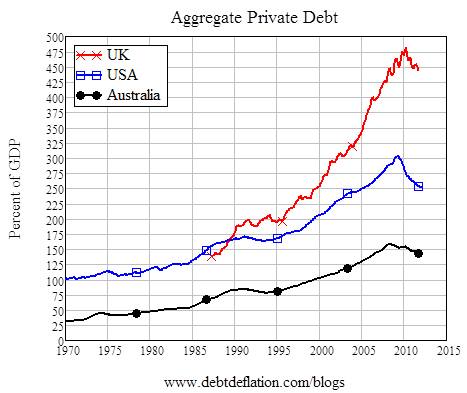 You may also want to read "Currency Crisis:Why is the British Pound a doomed currency ?" for a more detailed analysis of the United Kingdom debt and upcoming GBP currency crisis.
He managed to gather the data for aggregate private debt in the US and Australia and drew the result in the chart below:

I encourage you to read his blog post for details about private debt. I'm going to focus on 2 scenarios:
- Deflation where the central banks do not really fight the debt deflation (or debtflation).
- Inflation where the central banks decide to keep the aggregate private debt constant and works thru the years via inflation.
In this scenario, there would be massive deflation, and, in theory, the preferred asset would be cash (under the mattress) and many companies and banks would have to go bankrupt, but in reality, the system would probably have to collapse, and I'm not so sure what the value of cash would be. This is the kind of scenario envisioned by Robert Prechter who sees the Dow Jones at 1000 USD.
The other scenario (flat private debt to GDP ratio) would assume massive money printing. Let's assume somehow the federal reserve can keep this ratio constant by printing money during 23 years. If the GDP growth is flat, it would require about 3% (extra) inflation per year. However, during that period, there is actually a good chance of negative growth because Peak oil consequences will be in full effect unless we find some energy alternatives. This also excludes public debt and unfunded liabilities (about 100 trillions USD or 600% of GDP) which would require inflation north of 10% to get monetized.
If you think the US is in bad shape, just look at the aggregate private debt in the UK in the chart below. This country (and the British pound) are going to have a very rough time in the years and even decades ahead, as its private debt stands at 450% of GDP.

Thursday, March 15, 2012
GEAB 63: Global Systemic Crisis: The 5 Devastating Storms of Summer 2012 at the Heart of the Global Geopolitical Dislocation
Here are the highlights of GEAB 63 (March 2012) entitled "Global
Systemic Crisis: The 5 devastating storms of summer 2012 at the heart of global geopolitical dislocation":
- Global Systemic Crisis: The five devastating storms of summer 2012 at the heart of the global geopolitical dislocation. Global recession, debt crises, stock market crashes, potential war with Iran.
- Summer 2012: The US falls back into recession as Europe stagnates and BRICs slow down. LEAP 2012 predicts a global recession in 2012.
- Summer 2012: Central banks roadblocks and the rise of interest rates. The US federal reserve must now manage two new problems: the lack of demand for US treasuries and the rise of two other currencies: the Euro and the Chinese yuan.
- Summer 2012: Storm on currency markets and western public debts. After several attempts to stabilize exchange rates over the last few quarters, the failure to come to an agreement for a new currency at the G20 in order to build a new monetary system will lead to more currency volatility and further debt crises in western economies.
- Summer 2012: Iran, the war "too many". Whether this war occurs or not, it will be the war too many for the western world.
- Summer 2012: The new stock market and financial institutions crash. Iran's allies, such as China, are likely to hurt Washington financially by diversifying US dollar assets into other currencies.by announcing with Moscow that they will stop buying US treasuries in order to stop the US war machine.
- 2015: "The great fall of western real estate" - Excerpt of the chapter on the evolution of US residential real estate. As the US manufactures less and less, the country will become poorer and accelerated the fall of American real estate.
- Strategic and operational recommendations. Consequence of the emergence of 3 main monetary zones (US Europe and China). Inflection point for Gold. Commodities: conflict vs recession. End of the illusion for the US economy. Orange alert (whatever that means) on financial products..
- The GlobalEurometre - Results & Analyses. 85% of respondents think of European governance is being put into place.
Wednesday, February 15, 2012
GEAB 62: Euroland 2012-2016 : Perennisation of a New Global Power Contigent On Democratization
Here are the highlights of GEAB 62 (February 2012) entitled "Global
Systemic Crisis: Euroland 2012-2016 : Perennisation of a new global power contingent on democratization":
The full GEAB 62 (PDF format) is available to LEAP 2020 subscribers for 200 Euros per year (10 + 6 issues).
- Global Systemic Crisis: Euroland 2012-2016 : Perennisation of a New Global Power Contingent on Democratization. The Euroland will come out stronger of the crisis as long as people are involved in the Euroland project (and not just technocrats).
- 2013 : End of the US Dollar Supremacy in Global Commercial Transactions. The decreased amount of commercial transactions in US dollars will be the main trigger of the demise of the dollar, not USD currency reserves by foreign powers.
- 2015 – The Great Slump of Western Real Estate. LEAP 2020 forecasts important price correction for real estate in western economies by 2015. (Excerpt from a book to be published in March 2012)
- January 2012 GEAB $ Index: The US dollar accelerates its loss of value against the currency basket €, ¥, Ұ et R$.
- Strategic and operational recommendations. Many currencies will fall sharply, mind where you keep your Gold, solutions for Greece, winter stock market returns were a travesty and the coming great collapse of Western residential real estate.
- The GlobalEurometre - Results & Analyses. 69% of respondents (vs. 58% in January 2012) expect an important fall in the value of the US Dollar in the coming months.
The full GEAB 62 (PDF format) is available to LEAP 2020 subscribers for 200 Euros per year (10 + 6 issues).
Subscribe to:
Posts (Atom)