Showing posts with label sp500. Show all posts
Sunday, May 31, 2020
The Case for Stocks Going Higher - Retail Investors are Still Bearish
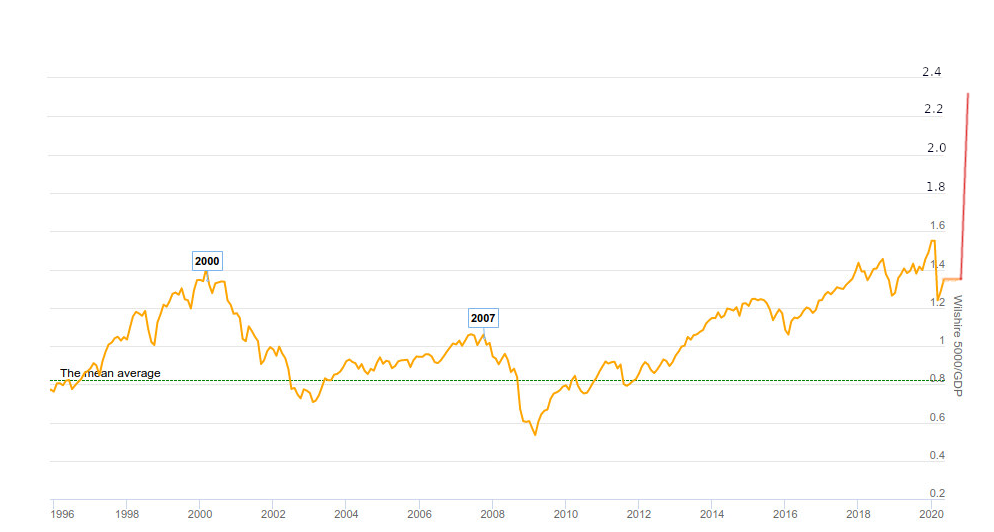
As we covered previously, there are plenty of metrics screaming the US stock market is in lalaland as one of the most overvalued markets (even before COVID-19), a complete disconnect between the economy and the stock market with the Wilshire 5000 to GDP ratio - aka Buffet Indicator - expected to reach around 230% by the end of July with the first Q2 GDP numbers.
When we asked whether the stock market rally was over on May 3rd, we noted the 1929 stock market rally took several months and our 1929 Redux simulation would take to it to May/June. We also pointed out one metric suggested it may have more legs: the AAII sentiment survey, or the bullishness/bearishness of the retail investor. We did not look into it too much at the time, so let's do that today by first looking at a 1998 to 2015 chart of the AAII bullishness 8-week moving average data courtesy of investing.com.
We can see every time the chart sharply drops below 25% it has been a buying opportunity. If you don't quite remember what the S&P 500 looks like for the period I have reproduced it below...
There were plenty of times when the ratio went under 30% between 1988 and 1994, and if you had purchased stock during that period you would have done well. Same thing for 2003 and 2009. In 2015, stocks may have looked overpriced, but the index was at around 2,000 points, and in May 31, 2020, the index is priced at around 3,000 or a 50% gain.
So what does the 8-week moving average of the AAII bullish sentiment index looks like today? Ycharts provides a free 5-year chart updating weekly for use to check.
At the time of the 2016 presidential election, the index was at 25%, a buying opportunity based on this index. But at the time, I was personally really wary of buying US stocks considering the length of the bull market, and other metrics.
What about today? The index stands at 29.50%, so retail investors are fairly bearish although not extremely so. Almost everything else cries "sell!!!", but the AAII sentiment survey tells me to wait a little longer, or strangely enough there should even be a buying opportunity, but I'd like to give it a pass.
Also, remember that's a presidential election year in the US, so politicians in power won't be shy to spend money they don't have, as we've seen in recent months in order to keep the system going, and are greatly helped with the federal reserve with their unlimited buying power. Could they just throw enough money at the system to keep it going for 5 more months until the election? I don't know but would not rule out the possibility.
While AAII sentiment survey looks useful to spot buying opportunity, it does not seem to be a good timing indicator for selling stocks. In 2000, it works, but was completely useless for the 2007 peak, and would have made people sell their stocks later in 2004, and in 2011 with bull markets in their early stages.
When we asked whether the stock market rally was over on May 3rd, we noted the 1929 stock market rally took several months and our 1929 Redux simulation would take to it to May/June. We also pointed out one metric suggested it may have more legs: the AAII sentiment survey, or the bullishness/bearishness of the retail investor. We did not look into it too much at the time, so let's do that today by first looking at a 1998 to 2015 chart of the AAII bullishness 8-week moving average data courtesy of investing.com.
We can see every time the chart sharply drops below 25% it has been a buying opportunity. If you don't quite remember what the S&P 500 looks like for the period I have reproduced it below...
There were plenty of times when the ratio went under 30% between 1988 and 1994, and if you had purchased stock during that period you would have done well. Same thing for 2003 and 2009. In 2015, stocks may have looked overpriced, but the index was at around 2,000 points, and in May 31, 2020, the index is priced at around 3,000 or a 50% gain.
So what does the 8-week moving average of the AAII bullish sentiment index looks like today? Ycharts provides a free 5-year chart updating weekly for use to check.
At the time of the 2016 presidential election, the index was at 25%, a buying opportunity based on this index. But at the time, I was personally really wary of buying US stocks considering the length of the bull market, and other metrics.
What about today? The index stands at 29.50%, so retail investors are fairly bearish although not extremely so. Almost everything else cries "sell!!!", but the AAII sentiment survey tells me to wait a little longer, or strangely enough there should even be a buying opportunity, but I'd like to give it a pass.
Also, remember that's a presidential election year in the US, so politicians in power won't be shy to spend money they don't have, as we've seen in recent months in order to keep the system going, and are greatly helped with the federal reserve with their unlimited buying power. Could they just throw enough money at the system to keep it going for 5 more months until the election? I don't know but would not rule out the possibility.
While AAII sentiment survey looks useful to spot buying opportunity, it does not seem to be a good timing indicator for selling stocks. In 2000, it works, but was completely useless for the 2007 peak, and would have made people sell their stocks later in 2004, and in 2011 with bull markets in their early stages.
Sunday, May 17, 2020
US Market Cap to GDP Forecast: 230% in Q2 2020
In our April 19 post entitled "All is Well! FAANG Stocks Hit All Times High as the Economy Collapses", we noted incredible disparities between the economy and the market. One of the metrics we used was the US market cap to GDP, aka the Buffet Indicator, which gives a sense of the valuation of the overall stock market (Willshire 5000) against the economy as measured by the GDP.
It was around 130& at the time, a level considered to represent an overvalued stock market, with 80% being fair-valued. As the stock market continued recovering, and the GDP "only" dropped by 4.8% in Q1 2020 for a total of 21.54 trillion dollars annualized, the ratio became slightly worse, and today it is at about 134%.
But once numbers for Q2 2020 come out, there will need to be adjustments. Either the stock market lowers to keep the ratio realistic, or it ignored the news, and the market cap to GDP goes to lalaland at levels never seen before... So what kind of scenario may happen? To find out we'll take the more recent Atlanta Fed GDPNow forecast for Q2 2020.
That would be a 42.8% drop (annualized). So If I understand correctly, we'd take the 21.54 trillion dollars mentioned in the introduction, and deduct 42.8% for it. Total: 12.32 trillion dollars or about the same amount of 2004 GDP.
Now that looks really bad, but it should also be temporary with massive jumps in GDP in Q3 and Q4 2020. If we get back to 18+ trillion dollars that would be a ~50% GDP growth over two quarters. Still significantly lower than previously, but that should allow some politicians to boast about economic performance...
What would that do to the US market cap to GDP ratio, if stocks were to stay at the current levels? We already have the estimated GDP (12.32 trillion), so we need the Wilshire 5000 market cap that is 28.77 trillion (courtesy of Ycharts).
That a cool ratio of 233% market cap to GDP... Let's represent this on a chart...
Beautiful! Although it's temporary, as it will come down as GDP eventually increases significantly once economies reopen.
Let's look at scenario two, where stocks magically adjust to the new GDP number. That one may not be quite realistic because markets are supposed to adjust themselves to future outcomes, although the markets have not been very good at it. But anyway, a 134% ratio would mean the Wilshire 5000 would drop from 28.77 trillion to 16.50 trillion, or a 42.6% drop.
Since most people don't follow the Wilshire 500, let's apply the 42.6% drop to the S&P 500 index at 2,863.70 points on May 15. That would make it drop to 1,643 points.
Q2 2020 GDP first official estimate is supposed to be released in July 2020, hence the strange shape of our chart. Note at 134% TCM to GDP, the stock market would be vastly overvalued if we ignore future GDP growth.
But let's take a more realistic scenario that assumes the Federal Reserve does not completely go crazy with the money supply. We would get back to 18 trillion GDP, with a fairly valued stock market (and fairly pessimistic investor sentiment) at 80% of GDP. In this case, the Wilshire 5000 would have a market capitalization of 14.4 trillion dollars. That's even lower than our case above but spread over a longer period of time. Where would be the S&P 500 then, let's say in H1 2021? That's roughly a 50% drop, meaning the S&P 500 would be around 1,430 points, the Dow Jones under 12,000. I think you get the point, no chart needed...
Happy investing, and good luck!
It was around 130& at the time, a level considered to represent an overvalued stock market, with 80% being fair-valued. As the stock market continued recovering, and the GDP "only" dropped by 4.8% in Q1 2020 for a total of 21.54 trillion dollars annualized, the ratio became slightly worse, and today it is at about 134%.
But once numbers for Q2 2020 come out, there will need to be adjustments. Either the stock market lowers to keep the ratio realistic, or it ignored the news, and the market cap to GDP goes to lalaland at levels never seen before... So what kind of scenario may happen? To find out we'll take the more recent Atlanta Fed GDPNow forecast for Q2 2020.
That would be a 42.8% drop (annualized). So If I understand correctly, we'd take the 21.54 trillion dollars mentioned in the introduction, and deduct 42.8% for it. Total: 12.32 trillion dollars or about the same amount of 2004 GDP.
Now that looks really bad, but it should also be temporary with massive jumps in GDP in Q3 and Q4 2020. If we get back to 18+ trillion dollars that would be a ~50% GDP growth over two quarters. Still significantly lower than previously, but that should allow some politicians to boast about economic performance...
What would that do to the US market cap to GDP ratio, if stocks were to stay at the current levels? We already have the estimated GDP (12.32 trillion), so we need the Wilshire 5000 market cap that is 28.77 trillion (courtesy of Ycharts).
That a cool ratio of 233% market cap to GDP... Let's represent this on a chart...
Beautiful! Although it's temporary, as it will come down as GDP eventually increases significantly once economies reopen.
Let's look at scenario two, where stocks magically adjust to the new GDP number. That one may not be quite realistic because markets are supposed to adjust themselves to future outcomes, although the markets have not been very good at it. But anyway, a 134% ratio would mean the Wilshire 5000 would drop from 28.77 trillion to 16.50 trillion, or a 42.6% drop.
Since most people don't follow the Wilshire 500, let's apply the 42.6% drop to the S&P 500 index at 2,863.70 points on May 15. That would make it drop to 1,643 points.
Q2 2020 GDP first official estimate is supposed to be released in July 2020, hence the strange shape of our chart. Note at 134% TCM to GDP, the stock market would be vastly overvalued if we ignore future GDP growth.
But let's take a more realistic scenario that assumes the Federal Reserve does not completely go crazy with the money supply. We would get back to 18 trillion GDP, with a fairly valued stock market (and fairly pessimistic investor sentiment) at 80% of GDP. In this case, the Wilshire 5000 would have a market capitalization of 14.4 trillion dollars. That's even lower than our case above but spread over a longer period of time. Where would be the S&P 500 then, let's say in H1 2021? That's roughly a 50% drop, meaning the S&P 500 would be around 1,430 points, the Dow Jones under 12,000. I think you get the point, no chart needed...
Happy investing, and good luck!
Sunday, May 3, 2020
May 2020 - Is the Bear Market Rally Over?
When we discussed whether 2020 might be the Great Depression of 1929 All Over Again on March 22, 2020, we applied the monthly Dow Jones chart variations of 1929 to the chart 2020 and noticed there may be a rebound soon.
and the market indeed started to rally almost immediately, then we thought we might get back to around 23,000 points by May/June, and plateau there for a while...
We've gone beyond that level to almost 25,000 now as shown by the 3-month daily until May 1st. So it might be a good time checking out technicals again, as we all know fundamentals look horrible.
The red line above corresponds to the 61.8% Fibonacci retracement, a bearish technical indicator that could indicate the bear market rally may be over, and we may at least re-test the low.
If we look at the 14-day relative strength index (RSI-14), we can see a top at 59.76 on April 29, not quite oversold just yet, but close to the level we were on February 18, 2020 top (RSI-14 = ~65).
Individual investors are not overly bullish and stay bearing on aggregate with a -13.43% bull-bear spread, which means this rally may last a bit longer.
In "normal times", I'd have no problem shorting this market, but with Central bank involvement we simply don't know where's it's going. The BOJ (Bank of Japan) has been printing money for years, and it has not helped their market a bit, but if we turn our eyes on Venezuela, and the Caracas market, money printing does work... when it comes to boosting the stock market.
That's over ten times return on investment over one year, and 210.94% since the beginning of 2020 in local currency... But the Venezuelan BolĂvar crashed compared to the US Dollar, and the country is suffering from hyperinflation, something that's highly unlikely in developed economies in the short term, but not completely impossible over the long term depending on central banks actions.
We still favor "sell in May and go away" for the S&P 500, Dow Jones, and most markets around the world.
![]() |
| 2020 Redux of 1929 Dow Jones chart |
and the market indeed started to rally almost immediately, then we thought we might get back to around 23,000 points by May/June, and plateau there for a while...
We've gone beyond that level to almost 25,000 now as shown by the 3-month daily until May 1st. So it might be a good time checking out technicals again, as we all know fundamentals look horrible.
The red line above corresponds to the 61.8% Fibonacci retracement, a bearish technical indicator that could indicate the bear market rally may be over, and we may at least re-test the low.
If we look at the 14-day relative strength index (RSI-14), we can see a top at 59.76 on April 29, not quite oversold just yet, but close to the level we were on February 18, 2020 top (RSI-14 = ~65).
Individual investors are not overly bullish and stay bearing on aggregate with a -13.43% bull-bear spread, which means this rally may last a bit longer.
In "normal times", I'd have no problem shorting this market, but with Central bank involvement we simply don't know where's it's going. The BOJ (Bank of Japan) has been printing money for years, and it has not helped their market a bit, but if we turn our eyes on Venezuela, and the Caracas market, money printing does work... when it comes to boosting the stock market.
That's over ten times return on investment over one year, and 210.94% since the beginning of 2020 in local currency... But the Venezuelan BolĂvar crashed compared to the US Dollar, and the country is suffering from hyperinflation, something that's highly unlikely in developed economies in the short term, but not completely impossible over the long term depending on central banks actions.
We still favor "sell in May and go away" for the S&P 500, Dow Jones, and most markets around the world.
Monday, February 4, 2013
S&P 500 Analysis: Valuation, Sentiment and Technicals - February 2013 Update
Last time I did this analysis was in January 2012, and I found out the US market was not particularly attractive with the S&P 500 just over 1,300, but not extended quite enough (AAII sentiment) to short it, the S&P 500 is now over 1,500, so let's update this long term analysis.
The CAPE stands at 22.77 vs 21.14 over a year ago, so by this metric the S&P 500 is even more overvalued than last year. Although it's still much lower than the CAPE in 2000, it's still high compared to historical CAPE, and at the level of previous tops in the stock market (1901, 1929 and 1966).
Many analysts like to look at the short term, and show that forward PE ratio is only about 14, and use this number to explain stocks are a pretty good bargain right now. In 2007, we had the same rhetoric, as forward PE was low because of high corporate earnings, which were widely above their long term trend.
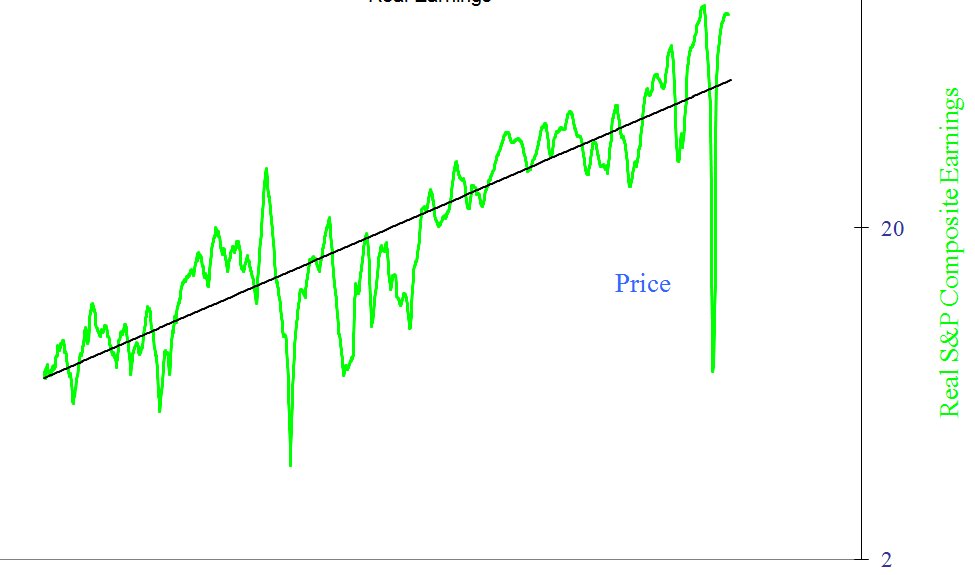
The chart above shows the S&P 500 earning adjust for inflation (real earning) between 1870 and today. We are clearly above trend, and this does not bode well for future returns.
Based on the 2 metrics above, the conclusion is the same as last year and it appears that based on valuation investing in the S&P 500 for the next several years might not be the best of ideas, or least it's rather risky.
But I like to look at the 14-week moving average of the AAII sentiment survey (which I call AAII-14), since I found it to be useful to identify some of the optimistic (and market) peaks of the past. The rule goes as follows: If the 14-week moving average of the AAII "Bullish" sentiment index is at 30% or below there could be a long term buying opportunity, above 50% there could be a long term sell opportunity.
Now this is getting interesting, as sentiment is pretty bullish, and AAII-14 getting closer to the 50% mark, even though it's not quite there for now.
The chart above (Yahoo Finance) is the 6 month chart of the S&P 500 with RSI-14, and we've been around 80 for a little while, which means the market is overbought in the short term.
NYA200R shows over 83% of stock are above their 200-day moving average, which is not very bullish for stocks either
Now let's get back the S&P 500 chart, but this time over 5 years, and let's try to draw bottom and top parallel trend lines.
We seem to have reached the top of the trend started since 2010, so a correction (at least in the short term) could occur very soon.
In the long term, the S&P 500 is overvalued by all measures, but market participant is not extreme just yet, so there could be a short term correction, followed by a rally before stocks head south for a longer period of times. Alternatively, it's also possible positive sentiment carries on the S&P 500 to new highs, and the long term reversal comes earlier than expected.
S&P 500 Valuation
The Shiller S&P 500 CAPE (10-year price earning ratio adjusted for inflation) is the reference to assess whether the S&P 500 is undervalued or overvalued over long periods of time. Here's what it looks like now:The CAPE stands at 22.77 vs 21.14 over a year ago, so by this metric the S&P 500 is even more overvalued than last year. Although it's still much lower than the CAPE in 2000, it's still high compared to historical CAPE, and at the level of previous tops in the stock market (1901, 1929 and 1966).
Many analysts like to look at the short term, and show that forward PE ratio is only about 14, and use this number to explain stocks are a pretty good bargain right now. In 2007, we had the same rhetoric, as forward PE was low because of high corporate earnings, which were widely above their long term trend.
The chart above shows the S&P 500 earning adjust for inflation (real earning) between 1870 and today. We are clearly above trend, and this does not bode well for future returns.
Based on the 2 metrics above, the conclusion is the same as last year and it appears that based on valuation investing in the S&P 500 for the next several years might not be the best of ideas, or least it's rather risky.
US Market Investors Sentiment
Based on last week AAII sentiment survey, investors are moderately bullish for the next 6 months.But I like to look at the 14-week moving average of the AAII sentiment survey (which I call AAII-14), since I found it to be useful to identify some of the optimistic (and market) peaks of the past. The rule goes as follows: If the 14-week moving average of the AAII "Bullish" sentiment index is at 30% or below there could be a long term buying opportunity, above 50% there could be a long term sell opportunity.
Now this is getting interesting, as sentiment is pretty bullish, and AAII-14 getting closer to the 50% mark, even though it's not quite there for now.
S&P 500 Technicals
We are now going to have a look at some technical indicators namely RSI-14 and NYA200R, as well as draw trend lines on the S&P 500 to see what it might do in the short term.The chart above (Yahoo Finance) is the 6 month chart of the S&P 500 with RSI-14, and we've been around 80 for a little while, which means the market is overbought in the short term.
NYA200R shows over 83% of stock are above their 200-day moving average, which is not very bullish for stocks either
Now let's get back the S&P 500 chart, but this time over 5 years, and let's try to draw bottom and top parallel trend lines.
We seem to have reached the top of the trend started since 2010, so a correction (at least in the short term) could occur very soon.
Conclusion
In the short term, all indicators shown above are bearish since they all indicate the market is overbought, so it's prudent to own less US stock at the moment, and traders may also consider shorting for the next few weeks/months.In the long term, the S&P 500 is overvalued by all measures, but market participant is not extreme just yet, so there could be a short term correction, followed by a rally before stocks head south for a longer period of times. Alternatively, it's also possible positive sentiment carries on the S&P 500 to new highs, and the long term reversal comes earlier than expected.
Thursday, August 16, 2012
Marc Faber: 2013 Will be a Difficult Year for Equities
Marc Faber is interviewed on CNBC Fast money about his market outlook.
He explains stocks (and gold) have traded in a narrow range in the last few days, and he expects a breakout, most probably on the downside, but he does not rule out new highs...
If the market goes down around 150 points, he expects the Fed to start QE3, 4, and the market could rebound, but he still think we have probably seen the high
for the year.
He concludes by saying 2013 will be a difficult year for stocks.
Thursday, May 10, 2012
Jim Rogers: Not a Good Time to Buy Stock, Might Sell Euros
Jim Rogers is interviewed by Henry Blodget on Business Insider on the 9th of May 2012.
Some people think it's the best time to buy stock in 50 years, but Jim Rogers disagrees. He does not own stock in the US, and heven have some shorts, and does not see how the US stock market could double within a few years as Dr. Jeremy Siegel claims, because the economy is in bad shape and will remain so for some time.
Henry Blodget then asks him if housing has bottomed, and here Jim Rogers agrees that real estate may have bottomed in some markets, and there may be good opportunities especially in the country side, but other places like Massachusetts have probably to go further down.
Switching to currencies... Although he's very pessimistic over the long term, he owns the US dollar, and might sell his Euro holdings because albeit Europeans have implemented austerities measures, they haven't managed to reduce their debt.
As previously stated, he expects Gold to correct further as it has gone up for 11 years in a row, but he will certainly buy if it goes down, and claims the Gold bull run is far from over and will probably end in a bubble, a Gold mania.
Finally, his views on crude oil haven't changed, the surprise is going to be how high it goes as reserves are going down, although a temporary correct could occur in case of serious crisis (e.g. Spain defaults on its debt).
Some people think it's the best time to buy stock in 50 years, but Jim Rogers disagrees. He does not own stock in the US, and heven have some shorts, and does not see how the US stock market could double within a few years as Dr. Jeremy Siegel claims, because the economy is in bad shape and will remain so for some time.
Henry Blodget then asks him if housing has bottomed, and here Jim Rogers agrees that real estate may have bottomed in some markets, and there may be good opportunities especially in the country side, but other places like Massachusetts have probably to go further down.
Switching to currencies... Although he's very pessimistic over the long term, he owns the US dollar, and might sell his Euro holdings because albeit Europeans have implemented austerities measures, they haven't managed to reduce their debt.
As previously stated, he expects Gold to correct further as it has gone up for 11 years in a row, but he will certainly buy if it goes down, and claims the Gold bull run is far from over and will probably end in a bubble, a Gold mania.
Finally, his views on crude oil haven't changed, the surprise is going to be how high it goes as reserves are going down, although a temporary correct could occur in case of serious crisis (e.g. Spain defaults on its debt).
Wednesday, April 18, 2012
Jeremy Grantham's Quarterly Newsletter April 2012 Summary
Jeremy Grantham, GMO, has just released its Quarterly Newsletter
entitled "My Sister’s Pension Assets and Agency Problems (The Tension between Protecting Your Job or Your Clients’ Money)".
In this newsletter, he focus on how career risk for people working in the investment business affects the markets. The first priority for professional investors is to keep their job, and for that reason they usually go with the flow to avoid being wrong on their own and be able to use the all convenient "nobody saw it coming". Career risk (which I discovered thanks to Jeremy Grantham) is what made me realize that as an individual investor, you could beat the market over the long term, as long as you are disciplined and patient.
Here are the key points brought forward by Jeremy Grantham:
GMO tries to find the right balance between short term client expectations and long term prospects, but this is challenging as it appears they lost 40% of their clients when they stayed out of the 1999/2000 stock market bubble. But as they were proven right as time passed by, the company eventually "attracted a flood of new business" in 2003 to 2006.
Before the 2008 crash, his sister portfolio had virtually 0% allocation in stocks, but GMO clients still had about 45%, again because of business risk.
GMO now offers a "Benchmark-Free Allocation Strategy" which allowed great return during last decade and reflects little career or business risk. The strategy intended to protect capital first and yet still make good money by taking into account historical trends and valuations.
The second part of the newsletter "Force Fed" written by Ben Inker provides GMO's investment outlook and explains how the Federal reverse market manipulation makes it to invest.
Here are the key points I noted:
In this newsletter, he focus on how career risk for people working in the investment business affects the markets. The first priority for professional investors is to keep their job, and for that reason they usually go with the flow to avoid being wrong on their own and be able to use the all convenient "nobody saw it coming". Career risk (which I discovered thanks to Jeremy Grantham) is what made me realize that as an individual investor, you could beat the market over the long term, as long as you are disciplined and patient.
Here are the key points brought forward by Jeremy Grantham:
- Career risk is a main cause of volatility: two-thirds of the time annual GDP growth and annual change in the fair value of the market is within plus or minus a tiny 1% of its long-term trend, whereas the market’s actual price is within plus or minus 19% two-thirds of the time.
- Ignoring long term trends may be the correct response on the part of most market players, for ignoring the volatile up-and-down market moves and attempting to focus on the slower
burning long-term reality is simply too dangerous in career terms. - The quote “The market can stay irrational longer than the investor can stay solvent.” can be expressed as “The market can stay irrational longer than the client can stay patient.” for investment companies. GMO found that clients patience time has been around 3 years on average in normal conditions.
- 3 conditions must be met to bet against market irrationality:
- Allow a “margin of safety” and wait for a real outlier before you make a big bet
- Stay reasonably diversified
- Never use leverage
GMO tries to find the right balance between short term client expectations and long term prospects, but this is challenging as it appears they lost 40% of their clients when they stayed out of the 1999/2000 stock market bubble. But as they were proven right as time passed by, the company eventually "attracted a flood of new business" in 2003 to 2006.
Before the 2008 crash, his sister portfolio had virtually 0% allocation in stocks, but GMO clients still had about 45%, again because of business risk.
GMO now offers a "Benchmark-Free Allocation Strategy" which allowed great return during last decade and reflects little career or business risk. The strategy intended to protect capital first and yet still make good money by taking into account historical trends and valuations.
The second part of the newsletter "Force Fed" written by Ben Inker provides GMO's investment outlook and explains how the Federal reverse market manipulation makes it to invest.
Here are the key points I noted:
- The Fed has engineered a situation in which the really unattractive asset classes are the ones we have always thought of as low risk: government bonds and cash. (etfideas: That's actually the main reason why I hate the fed)
- Stocks are expensive relative to GMO estimate of long-term fair value, but so are bonds and cash.
- Australian and New Zealand government bonds are the only bonds (unenthusiastically) liked by GMO because of decent real yield and government spending policies that are sustainable in the
long run.
Monday, February 13, 2012
Gold Outperformed the S&P 500 For the Period 1965-2012
I've seen an article on Fortune magazine written by Warren Buffett that shows the graphics on the right showing the S&P 500 outperformed Gold since 1965.
Warren Buffett also explained his preference for stocks as follows:
There are two interesting facts:
For the formulas, you can check the S&P 500 vs Gold - 1965 - 2000 Spreadsheet.
So if I'm correct, Gold clearly outperformed the S&P 500 (including dividends) during that period. To be fair, if they had chosen 1950 has the starting we may have a different story.
Warren Buffett also explained his preference for stocks as follows:
Today the world's gold stock is about 170,000 metric tons. If all of this gold were melded together, it would form a cube of about 68 feet per side. (Picture it fitting comfortably within a baseball infield.) At $1,750 per ounce -- gold's price as I write this -- its value would be about $9.6 trillion. Call this cube pile A.
Let's now create a pile B costing an equal amount. For that, we could buy all U.S. cropland (400 million acres with output of about $200 billion annually), plus 16 Exxon Mobils (the world's most profitable company, one earning more than $40 billion annually). After these purchases, we would have about $1 trillion left over for walking-around money (no sense feeling strapped after this buying binge). Can you imagine an investor with $9.6 trillion selecting pile A over pile B?
A century from now the 400 million acres of farmland will have produced staggering amounts of corn, wheat, cotton, and other crops -- and will continue to produce that valuable bounty, whatever the currency may be. Exxon Mobil will probably have delivered trillions of dollars in dividends to its owners and will also hold assets worth many more trillions (and, remember, you get 16 Exxons). The 170,000 tons of gold will be unchanged in size and still incapable of producing anything. You can fondle the cube, but it will not respond.Considering peak oil is around the corner, Exxon Mobil may not be the best example ever, as it might be worth zero in 100 years, along with lots of other stocks 9if not all stocks). But let's go back to the subject of the S&P 500 outperforming Gold since 1965. I have edited an excel spreadsheet to calculate the return of the S&P 500 including dividends since 1965 (but excluding fees and taxes) as well the same return with Gold (again excluding premiums and taxes) and drawn the chart shown below (Click to enlarge).
There are two interesting facts:
- Gold and Stocks appear to work in cycles, with period where stocks massively outperform Gold and vice versa. A logarithmic chart would show Gold is just at the onset of this cycle and should go much higher vs. stocks in the S&P 500. So there is no "Gold is better than Stocks' or "Stocks are better than Gold", there are just wealth cycles.
- If I find the same result as Fortune for Gold appreciation since 1965, I just find 100 US dollars invested in the S&P 500 in 1965 would have returned 3370 USD whereas Fortune found those 100 USD would have turn into 6072 USD. I also reinvested dividend (at the end of the year) in stocks for each year.
For the formulas, you can check the S&P 500 vs Gold - 1965 - 2000 Spreadsheet.
So if I'm correct, Gold clearly outperformed the S&P 500 (including dividends) during that period. To be fair, if they had chosen 1950 has the starting we may have a different story.
Saturday, January 28, 2012
US Markets Valuation, Sentiment and Technical Analysis - January 2012
In recent weeks, the S&P 500 has performed very well, almost reaching 2011 highs. At the same time, several indicators would seem to indicate a recession is coming to the US in 2012 and the Baltic dry Index does not look good either.
Today, I'm going to look at US markets, both in terms of valuation and sentiment. I will also look into technical factors to help determine whether it is a good time to sell or even short US markets.
S&P 500 Valuation.
For long term investors, Shiller S&P 500 CAPE (10-year price earning ratio adjusted for inflation) is the reference to assess whether the S&P 500 is undervalued or overvalued. Here's what it looks like today:
The CAPE stands at 21.14, it's much lower than the CAPE in 2000 (That is when Shiller talked about "irrational exuberance"), but still high compared to historical CAPE (average is around 15-16).
Another way, I like to look at valuation is by looking at earnings only. Historically, they've had a tendency to increase at a fix rate over long period of time and always oscillate around the trend line. That's the "mean reversion" preached by Jeremy Grantham. Here's the logarithmic chart of S&P 500 inflation-adjusted earnings between 1870 and 2012.
In 2011, earnings are above average and will revert to the mean at some point. Of course this could be this year or in several years.
Based on the 2 metrics above, it seems that based on valuation it is rather risky to invest in the S&P 500 or at least it's likely to average disappointing returns.
US Market Investors Sentiment.
Previously I liked to follow Market Harmonics Bull/Bear ratio, but it is not a free service anymore since last April. Now, I use the AAII sentiment index instead:
Week ending 1/25/2012
However, I like to look at things in a longer term perspective using AAII-14, as explained in my post "Using AAII Sentiment Survey to Time the Market". If the 14-week moving average of the AAII "Bullish" sentiment index is at 30% or below is a long term buy, above 50% it is a long term sell.
Now the AAII-14 is at about 42%, so this is neutral.
S&P 500 Technicals.
I'm now going to look at my 2 favorites technical metrics the RSI-14 and the index showing the percentage of stocks above their 200-day moving average (NYA200R).
I use the 14-day relative strength index moving average for short term moves.
The S&P 500 6-month chart and RSI-14 chart (Source: Yahoo Finance) shows it is now at 76.20. On the 23rd of January the RSI-14 was at 87.57 which was overbought, so a short term correction should be expected.
The NYA200R is really the index which tell me "wait" when other indicators tell me to buy or sell. Here's what it looks like today. (Source: StockCharts.com)
Today, I'm going to look at US markets, both in terms of valuation and sentiment. I will also look into technical factors to help determine whether it is a good time to sell or even short US markets.
S&P 500 Valuation.
For long term investors, Shiller S&P 500 CAPE (10-year price earning ratio adjusted for inflation) is the reference to assess whether the S&P 500 is undervalued or overvalued. Here's what it looks like today:
The CAPE stands at 21.14, it's much lower than the CAPE in 2000 (That is when Shiller talked about "irrational exuberance"), but still high compared to historical CAPE (average is around 15-16).
Another way, I like to look at valuation is by looking at earnings only. Historically, they've had a tendency to increase at a fix rate over long period of time and always oscillate around the trend line. That's the "mean reversion" preached by Jeremy Grantham. Here's the logarithmic chart of S&P 500 inflation-adjusted earnings between 1870 and 2012.
In 2011, earnings are above average and will revert to the mean at some point. Of course this could be this year or in several years.
Based on the 2 metrics above, it seems that based on valuation it is rather risky to invest in the S&P 500 or at least it's likely to average disappointing returns.
US Market Investors Sentiment.
Previously I liked to follow Market Harmonics Bull/Bear ratio, but it is not a free service anymore since last April. Now, I use the AAII sentiment index instead:
Week ending 1/25/2012
| Bullish | up 1.2 |
||
| Neutral | up 3.5 |
||
| Bearish | down 4.7 | ||
According the AAII, the long term average are as follows: Bullish: 39%, Neutral: 31% and Bearish: 30%.
That shows people are now pretty optimist about the future. As a contrarian, that would be a bearish sign.However, I like to look at things in a longer term perspective using AAII-14, as explained in my post "Using AAII Sentiment Survey to Time the Market". If the 14-week moving average of the AAII "Bullish" sentiment index is at 30% or below is a long term buy, above 50% it is a long term sell.
Now the AAII-14 is at about 42%, so this is neutral.
S&P 500 Technicals.
I'm now going to look at my 2 favorites technical metrics the RSI-14 and the index showing the percentage of stocks above their 200-day moving average (NYA200R).
I use the 14-day relative strength index moving average for short term moves.
The S&P 500 6-month chart and RSI-14 chart (Source: Yahoo Finance) shows it is now at 76.20. On the 23rd of January the RSI-14 was at 87.57 which was overbought, so a short term correction should be expected.
The NYA200R is really the index which tell me "wait" when other indicators tell me to buy or sell. Here's what it looks like today. (Source: StockCharts.com)
At 65.10%, the NYA200R tells me there is probably more upside potential for the S&P 500. I would become wary of holding stocks if it reached 80% or more for several weeks/month.
Conclusion
As some indicators suggest, there are significant recession risks for 2012. The S&P 500 seems relatively overvalued compared to historical ratios. Short term investors are very bullish and the market is overbought. However, longer term, it appears we have to not reached extreme bullishness (as the AAII-14 implies) and the NYA200R would suggest stocks have still more upside.
Based on this analysis, I would personally not add any position at the moment because of valuation and short-term bullishness and would even consider decreasing exposure to US stocks. I would not short the market however, because not all indicators are extreme and we have mad men (e.g. Ben Bernanke) and women (e.g. Janet Yellen) at the head of the US federal reserve that could unleash QE3 after announcing zero interest rates until 2014 since week.
Friday, January 20, 2012
Marc Faber: Relax! Stocks Won't Collpase
Marc Faber is interviewed by CNN on the 20th of January 2012.
First, they discuss he views that US bonds should be rated Junk, with the debt increasing from 1 trillion dollars in 1990 to 5 trillion dollars in 2000 to now over 15 trillion dollars and if we include unfunded liabilities the number would be much higher (something like 100 trillion dollars).
Now, the debt can be serviced because of low interest rates, but if those would be to increase, it would become much more problematic.
Marc Faber also explained that everybody should relax, equities won't collpase because there isa stron (technical) support at 1100 on the S&P 500, and if the S&P 500 drops 200 points, the federal reserve will start QE3.
Finally, he said that Asian banks (in Thailand and Singapore) are a much safer place than western banks for deposit and that contrary to popular beliefs, emerging economies do no rely so much on the west to sustain themselves.
First, they discuss he views that US bonds should be rated Junk, with the debt increasing from 1 trillion dollars in 1990 to 5 trillion dollars in 2000 to now over 15 trillion dollars and if we include unfunded liabilities the number would be much higher (something like 100 trillion dollars).
Now, the debt can be serviced because of low interest rates, but if those would be to increase, it would become much more problematic.
Marc Faber also explained that everybody should relax, equities won't collpase because there isa stron (technical) support at 1100 on the S&P 500, and if the S&P 500 drops 200 points, the federal reserve will start QE3.
Finally, he said that Asian banks (in Thailand and Singapore) are a much safer place than western banks for deposit and that contrary to popular beliefs, emerging economies do no rely so much on the west to sustain themselves.
Labels:
asia,
cnn,
debt,
emerging markets,
marc faber,
sp500,
stocks,
thailand,
us,
us debt
Sunday, October 30, 2011
Market Predictions for 2012 based on Trends
Last week, I reported Bloomberg Consensus of Predictions for Year-End 2012 in Where are Markets Headed for 2012 ?
That was their average forecast:
- S&P 500: 1,428 vs Current: 1,229
- 10-year Treasury yield: 2.86% vs Current: 2.14%
- Inflation rate: 2.05% vs Current: 3.9%
- Unemployment rate: 8.7% vs Current: 9.1%
- GDP growth in fourth quarter: 2.5% vs Second quarter, 2011: 1.3%
- Gold price per ounce on Sept. 30, 2012: $1,835 vs Current: $1,704
- Value of euro: $1.40 vs Current: $1.39
- S&P/Case-Shiller 20-City Composite Home Price Index: 136.6 vs Current: 142.8
- Barrel of oil: $95 vs Current: $92.58
- S&P 500: 1000
- 10-Year Treasury yields: 2.5%
- Inflation Rate: 2.5%
- Unemployment Rate: 8.8%
- GDP Growth Rate: 1%
- Gold Price: 1850 USD
- Euro: 1.37 US dollar
- S&P Case-Shiller 20-City Composite Home Price Index: 135
- Barrel of Oil (WTI): 125 US dollar
Friday, October 28, 2011
Where are Markets Headed for 2012 ?
Bloomberg Consensus of Predictions for Year-End 2012 (unless otherwise noted):
1. UP Standard & Poor’s 500-stock index: 1,428 Current: 1,229
2. UP 10-year Treasury yield: 2.86% Current: 2.14%
3. DOWN Inflation rate: 2.05% Current: 3.9%
4. DOWN Unemployment rate: 8.7% Current: 9.1%
5. UP GDP growth in fourth quarter: 2.5% Second quarter, 2011: 1.3%
6. UP Gold price per ounce on Sept. 30, 2012: $1,835 Current: $1,704
7. UP Value of euro: $1.40 Current: $1.39
8. DOWN S&P/Case-Shiller 20-City Composite Home Price Index: 136.6 Current: 142.8
9. UP Barrel of oil: $95 Current: $92.58
Analysts are rather optimistic, except for the Case-Shiller index.
They also don't see huge swings in the markets (they never do).
Thursday, September 8, 2011
Using AAII Sentiment Survey to Time the Market
I previously used Market Harmonics Investor Intelligence Survey bull / bear ratio to help me decide whether it would be a good time to invest. As a contrarian investor, a bearish sentiment would indicate a good time to buy and a bullish sentiment would have me stay on the sidelines or sell. However, since the 20th April 2011, they decided to discontinue publishing weekly data from Investors Intelligence and those who wish to obtain weekly Investors Intelligence reports have to subscribe to www.investorsintelligence.com.
Luckily there are other measure of investors confidence such as AAII Sentiment Survey or State Street Investor Confidence Index. The former is a weekly survey of American individual investors, the latter is an index based on North American, European and Asian investors portfolios published monthly.
Today, I'll study the AAII Sentiment Index between 1987 and today to see if it can be used by long term investors to time the market.
The first chart is composed of the S&P 500 (on top) and the 14-day moving average of the percentage of bullish investors (Bottom), since the raw data looks like noise to me.
We can see that during the previous bull market (between 1987 and 2000) on this chart, confidence seemed to build up over time, and since 2000, confidence seem to follow a slow downward trend.
The next chart is identical, except I add buy and sell signals. A buy signal is when the bullish sentiment moving average is at or under 30% and a sell signal when it is over 50%.
Based on those signals, an investor would have bought stocks numerous times between 1987 and 1994, possibly sell in 1997, buy again in 1998 and sell in 2000. During that period, this would have clearly been a winning strategy even tough the investor would have missed positive returns between 1997 and 1998, or possibly completely missed the bubble between 1997 and 2000. But positive returns are extremely easy in a bull market.
Let's see how it performed since 2000. There was another sell signal in 2002, but possibly the investor would not have acted on it due to all the sell signals in 2000. There was a brief buy signal in 2003 (that could have been missed) and then another sell signal shortly afterwards in 2003-2004, so the investor would have missed the 2003-2007 bull market.
Then there would have been a buy signal around Q2 2008 (Bad call) and another in Q1 2009 (Good call), before the last sell signal around Q1 2011.
To conclude, even though this method is far from perfect, it would still have outperformed the market between 2000 and 2011. Usually, one indicator is not sufficient to make a decision, and you may want to use other indicators such as the 14-day Relative Strength Index (RSI) for the S&P 500 or the percentage of stocks above their 200-day moving average as explained in "Is the Stock Market fall over?" Long term investors should also follow Case Shiller CAPE (Cyclically Adjusted Price Earning), with a CAPE below 10 being a buy signal. But you'd have to be very patient...
Luckily there are other measure of investors confidence such as AAII Sentiment Survey or State Street Investor Confidence Index. The former is a weekly survey of American individual investors, the latter is an index based on North American, European and Asian investors portfolios published monthly.
Today, I'll study the AAII Sentiment Index between 1987 and today to see if it can be used by long term investors to time the market.
The first chart is composed of the S&P 500 (on top) and the 14-day moving average of the percentage of bullish investors (Bottom), since the raw data looks like noise to me.
We can see that during the previous bull market (between 1987 and 2000) on this chart, confidence seemed to build up over time, and since 2000, confidence seem to follow a slow downward trend.The next chart is identical, except I add buy and sell signals. A buy signal is when the bullish sentiment moving average is at or under 30% and a sell signal when it is over 50%.
Based on those signals, an investor would have bought stocks numerous times between 1987 and 1994, possibly sell in 1997, buy again in 1998 and sell in 2000. During that period, this would have clearly been a winning strategy even tough the investor would have missed positive returns between 1997 and 1998, or possibly completely missed the bubble between 1997 and 2000. But positive returns are extremely easy in a bull market.Let's see how it performed since 2000. There was another sell signal in 2002, but possibly the investor would not have acted on it due to all the sell signals in 2000. There was a brief buy signal in 2003 (that could have been missed) and then another sell signal shortly afterwards in 2003-2004, so the investor would have missed the 2003-2007 bull market.
Then there would have been a buy signal around Q2 2008 (Bad call) and another in Q1 2009 (Good call), before the last sell signal around Q1 2011.
To conclude, even though this method is far from perfect, it would still have outperformed the market between 2000 and 2011. Usually, one indicator is not sufficient to make a decision, and you may want to use other indicators such as the 14-day Relative Strength Index (RSI) for the S&P 500 or the percentage of stocks above their 200-day moving average as explained in "Is the Stock Market fall over?" Long term investors should also follow Case Shiller CAPE (Cyclically Adjusted Price Earning), with a CAPE below 10 being a buy signal. But you'd have to be very patient...
Tuesday, August 23, 2011
Marc Faber: Stock Market Rally Could Last Longer
Marc Faber is interviewed by Bloomberg on the 23rd of August 2011.
He said that due to technical the current rally could carry on for a while.
He also said that both extra bear and bull are likely to be disappointed, as we are not likely to revisit the May 2011 highs nor test the lows of March 2009.
Finally, he discusses about what he expects from the Federal Reserve meeting in Jackson Hole later this week.
He said that due to technical the current rally could carry on for a while.
He also said that both extra bear and bull are likely to be disappointed, as we are not likely to revisit the May 2011 highs nor test the lows of March 2009.
Finally, he discusses about what he expects from the Federal Reserve meeting in Jackson Hole later this week.
Will US Stocks stay in a Bear Market until 2014 ?
The answer could be yes according to a paper by FRBSF entitled "Boomer Retirement: Headwinds for U.S. Equity Markets?" where they compared price earning ratio in relation to demographics.
The first chart (above) compared the inflation adjusted P/E ratio of the S&P 500 to the M/O ratio. The M/O ratio is the ratio of the middle-age cohort, age 40–49, to the old-age cohort, age 60–69. As we can see the two seems correlated.
The second chart is where it becomes to be very interesting. Based on expected demographic trends (usually quite predictable), they created a model to see what the P/E ratio would look like in the years ahead. As we can see on the cahrt above, the P/E ratio is expected to bottom out around 2024 according to their model. That would mean another 13 years of bear market for the S&P 500.
This is also in accordance with Schiller's 10-year inflation adjusted P/E chart, where it shows bear market usually end with P/E below 10, except it does not provide timing.
Thursday, August 4, 2011
Is the Stock Market fall over ?
I'll base my assessment of the same criteria I used in my previous blog post "Bearish Sign: Extreme Bullishness for US stock market" published on the 7th of April 2011.
Since that time, Investor Intelligence does not freely publish its Bull/Bear Ratio and you have to be a paying member to access this information (which I'm not). However, I found a study published on the 31st of July 2011 that makes use of this data (Up to 26 July).
So on the 26th of July, the bull bear ratio was around 2.3. It has certainly dropped below 2 since then considering the sharp decline in the S&P 500. But we can't really that to make a decision.
The 14-day Relative Strength Index (RSI) for the S&P 500 is about 24 , which is usually a sign of an oversold market at least in the short time.. However, notice that the S&P 500 (below) has broken the bullish trends it started in March 2009.
Finally, let's have a look on the percentage of stocks above their 200-day moving average.

23 percent of stocks are now above the 200 MA, this is a level not seen since the market crash of 2008, and could indicate stocks have not much further to drop.
To conclude, if you believe that central banks will come to the rescue (say Q3) if the market falls further (as Marc Faber does), this may be a pretty good time to buy stocks (in the US or abroad) or add to your positions. However, if they wait and see, the market could fall much more (before it goes up again) especially if advanced economies falls into recession or the long awaited slowdown of the Chinese economy materializes.
Since that time, Investor Intelligence does not freely publish its Bull/Bear Ratio and you have to be a paying member to access this information (which I'm not). However, I found a study published on the 31st of July 2011 that makes use of this data (Up to 26 July).
So on the 26th of July, the bull bear ratio was around 2.3. It has certainly dropped below 2 since then considering the sharp decline in the S&P 500. But we can't really that to make a decision.The 14-day Relative Strength Index (RSI) for the S&P 500 is about 24 , which is usually a sign of an oversold market at least in the short time.. However, notice that the S&P 500 (below) has broken the bullish trends it started in March 2009.
Finally, let's have a look on the percentage of stocks above their 200-day moving average.
23 percent of stocks are now above the 200 MA, this is a level not seen since the market crash of 2008, and could indicate stocks have not much further to drop.
To conclude, if you believe that central banks will come to the rescue (say Q3) if the market falls further (as Marc Faber does), this may be a pretty good time to buy stocks (in the US or abroad) or add to your positions. However, if they wait and see, the market could fall much more (before it goes up again) especially if advanced economies falls into recession or the long awaited slowdown of the Chinese economy materializes.
Labels:
bear,
etf,
investor intelligence,
marc faber,
nya200r,
rsi,
sp500,
stocks,
usa
Thursday, April 7, 2011
Bearish Sign: Extreme Bullishness for US stock market
The latest Market Harmonics intelligence survey shows a Bull/Bear Ratio of 3.65, the highest ratio of the last 5 years.

See bull and bear charts here:
http://www.market-harmonics.com/free-charts/sentiment/investors_intelligence.htm
The 14-day Relative Strength Index (RSI) for the S&P 500 is around 60, if we pass the previous high of 1344 on the S&P500 with an RSI at 70 or over, it might be better to be prudent and decrease positions in stock that have outperformed worldwide, especially since the RSI has not gone below 30 since July 2010. Said that, we are not near the top of the channel we followed since March 2009.

Finally, I'll have a look on the percentage of stocks above their 200-day moving average with a chart from StockCharts.com for $nya200r.
Currently 83.70 percent of stocks are above the 200 MA, this is not extreme, but certainly does not encourage us to buy stocks especially this has been around 80 for a while.
To conclude, if the S&P 500 reaches a new high this month, it is most probably wise to sell part of your investment in stocks and possibly industrial commodities be it ETF or other financial instruments.

See bull and bear charts here:
http://www.market-harmonics.com/free-charts/sentiment/investors_intelligence.htm
The 14-day Relative Strength Index (RSI) for the S&P 500 is around 60, if we pass the previous high of 1344 on the S&P500 with an RSI at 70 or over, it might be better to be prudent and decrease positions in stock that have outperformed worldwide, especially since the RSI has not gone below 30 since July 2010. Said that, we are not near the top of the channel we followed since March 2009.

Finally, I'll have a look on the percentage of stocks above their 200-day moving average with a chart from StockCharts.com for $nya200r.
Currently 83.70 percent of stocks are above the 200 MA, this is not extreme, but certainly does not encourage us to buy stocks especially this has been around 80 for a while.To conclude, if the S&P 500 reaches a new high this month, it is most probably wise to sell part of your investment in stocks and possibly industrial commodities be it ETF or other financial instruments.
Subscribe to:
Posts (Atom)