Showing posts with label rsi. Show all posts

Sunday, June 28, 2020

S&P 500 Analysis: Valuation, Sentiment and Technicals - June 2020

It's been a very long time since I have done an S&P 500 analysis with valuation, sentiment and technical indicators taken into account. So let's get an updated picture for June 2020.

S&P 500 Valuation


One way to look at value is to check out the CAPE 10 ratio (Cyclically Adjusted
Price Earnings Ratio over a 10-year period). It now stands at close to 30, and that's before "COVID-19" earnings are released.


That's historically very elevated and similar to the 1929 stock market bubble. Expect the number to shoot with earning announcements if the stock market does not correct first.

Corporate earnings tend to revert to the mean over time.


It's a lagging indicator, as Q2 earnings have not been announced just yet. But the chart shows earnings were way above the historical trend before the crisis. July will be interested as earnings announcement will mean this number possibly goes negative.

AAII Sentiment

The stock market is all about people's feelings, and AAII members are not buying the rally, as they have still 48.9% bearish.
AAII Sentiment Survey June 2020
We can see the 8-week moving average bullishness chart is still very low.
AAII Sentiment Survey Chart June 2020

The AAII sentiment survey used to be a contrarian indicator, but I'm not sure it's still the case. This would mean stocks have further gains, but in this case I suppose AAII investor believe the market will go down in the next six months, and did not really participate in the rally..

Technical Indicators


The RSI-14 (14-day relative strength index) can help us find out if a market is oversold or overbought.
RSI-14 S&P 500 June 2020

The RSI-14 is now at 54 or close to neutral. This compares to close to 80 in January/February when markets were clearly overbought in the short term.

The NYA200R (percentage of stocks over their 200-day moving average) can be used to determine if only a few stocks participated in a rally.

NYA200R  Weekly Chart June 2020


The current chart shows only about 25% of stocks are above their 200-day moving average meaning the elevated S&P 500 stock market level may be due to some  larger capitalization, while smaller stocks are still suffering, or not participating in the rally just as much.

Conclusion

Apart from the US stock market valuation metrics to which we could add the stock market to GDP ratio, we are not really at extremes while looking at sentiment and technical indicators. So I would be very wary of going long, but at the same time the rally may not be over. Another important metrics for investors in 2020 will also be the Federal Reserve assets purchases, but it's pretty hard to forecast what a small group of people will do, especially during a presidential election year.

Monday, February 18, 2013

Gold - Long Term Chart Says Buy Now!

Since 2001, Gold has been behaving very nicely and stayed in a narrow range in its logarithmic chart. So If Gold has gone down for an extended period of time and suddenly drop at level not seen for a while, or alternatively if it has gone up for a long time, and makes new highs, I like to have a look at the logarithmic chart since the bull market started in 2001, and see is we've hit the higher or lower bound of the trend
(Source: Boursorama)
Guess what, we've just hit the lower bound last Friday. Assuming long term fundamentals remain the same (debt issue, money printing...), Gold is likely to go up over time, and this could prove to be the right time to buy. The 14-day RSI is at 30 (and hit this level 3 times) which means Gold is oversold short term. So it looks like a long and short term buy at this level.

The only thing that bothers me is that is has mostly corrected through time, and not really through price (it only lost 15%) which means it keep it amazing record of 12 positive years. Which is probably why Georges Soros recently lightened his position, and Jim Rogers said he would not buy at those levels. however, Marc Faber still continues to advice buying every month.

The Gold chart may also indicate it's a good time to buy Silver which has gone down by over 40% since the $50 it hit in 2011, but it's still not technically oversold (yet).

Monday, February 4, 2013

S&P 500 Analysis: Valuation, Sentiment and Technicals - February 2013 Update

Last time I did this analysis was in January 2012, and I found out the US market was not particularly attractive with the S&P 500 just over 1,300, but not extended quite enough (AAII sentiment) to short it, the S&P 500 is now over 1,500, so let's update this long term analysis.

S&P 500 Valuation

The Shiller S&P 500 CAPE (10-year price earning ratio adjusted for inflation) is the reference to assess whether the S&P 500 is undervalued or overvalued over long periods of time. Here's what it looks like now:


The CAPE stands at 22.77 vs 21.14 over a year ago, so by this metric the S&P 500 is even more overvalued than last year. Although it's still much lower than the CAPE in 2000, it's still high compared to historical CAPE, and at the level of previous tops in the stock market (1901, 1929 and 1966).

Many analysts like to look at the short term, and show that forward PE ratio is only about 14, and use this number to explain stocks are a pretty good bargain right now. In 2007, we had the same rhetoric, as forward PE was low because of high corporate earnings, which were widely above their long term trend.
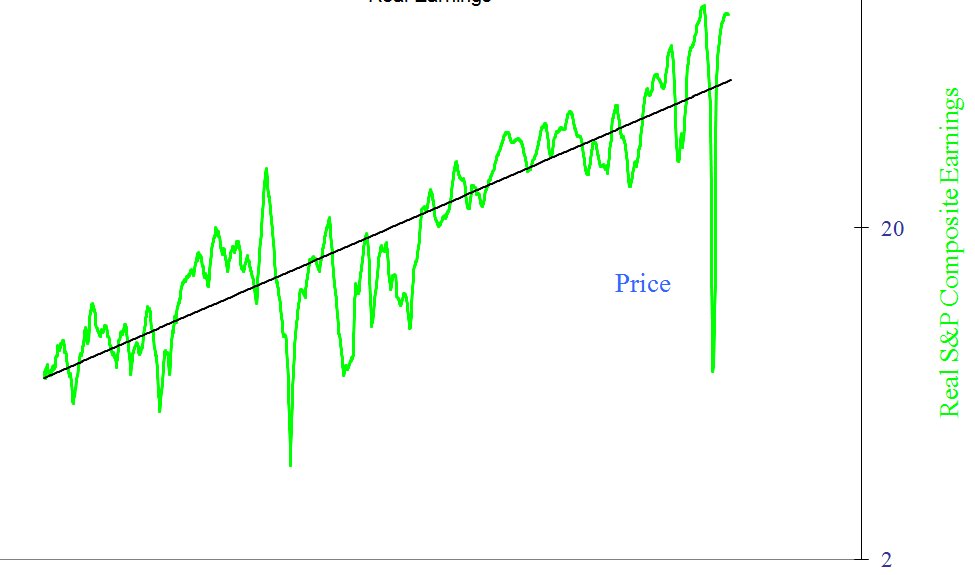
The chart above shows the S&P 500 earning adjust for inflation (real earning) between 1870 and today. We are clearly above trend, and this does not bode well for future returns.

Based on the 2 metrics above, the conclusion is the same as last year and it appears that based on valuation investing in the S&P 500 for the next several years might not be the best of ideas, or least it's rather risky.


US Market Investors Sentiment

Based on last week AAII sentiment survey, investors are moderately bullish for the next 6 months.
But I like to look at the 14-week moving average of the AAII sentiment survey (which I call AAII-14), since I found it to be useful to identify  some of the optimistic (and market) peaks of the past. The rule goes as follows: If the 14-week moving average of the AAII "Bullish" sentiment index is at 30% or below there could be a long term buying opportunity, above 50% there could be a long term sell opportunity.


Now this is getting interesting, as sentiment is pretty bullish, and AAII-14 getting closer to the 50% mark, even though it's not quite there for now.

S&P 500 Technicals

We are now going to have a look at some technical indicators namely RSI-14 and NYA200R, as well as draw trend lines on the S&P 500 to see what it might do in the short term.


The chart above (Yahoo Finance) is the 6 month chart of the S&P 500 with RSI-14, and we've been around 80 for a little while, which means the market is overbought in the short term.

NYA200R shows over 83% of stock are above their 200-day moving average, which is  not very bullish for stocks either
Now let's get back the S&P 500 chart, but this time over 5 years, and let's try to draw bottom and top parallel trend lines.


We seem to have reached the top of the trend started since 2010, so a correction (at least in the short term) could occur very soon.

Conclusion

In the short term, all indicators shown above are bearish since they all indicate the market is overbought, so it's prudent to own less US stock at the moment, and traders may also consider shorting for the next few weeks/months.

In the long term, the S&P 500 is overvalued by all measures, but market participant is not extreme just yet, so there could be a short term correction, followed by a rally before stocks head south for a longer period of times. Alternatively, it's also possible positive sentiment carries on the S&P 500 to new highs, and the long term reversal comes earlier than expected.

Saturday, January 28, 2012

US Markets Valuation, Sentiment and Technical Analysis - January 2012

In recent weeks, the S&P 500 has performed very well, almost reaching 2011 highs. At the same time, several indicators would seem to indicate a recession is coming to the US in 2012 and the Baltic dry Index does not look good either.

Today, I'm going to look at US markets, both in terms of valuation and sentiment. I will also look into technical factors to help determine whether it is a good time to sell or even short US markets.

S&P 500 Valuation.

For long term investors, Shiller S&P 500 CAPE (10-year price earning ratio adjusted for inflation) is the reference to assess whether the S&P 500 is undervalued or overvalued. Here's what it looks like today:

 The CAPE stands at 21.14, it's much lower than the CAPE in 2000 (That is when Shiller talked about "irrational exuberance"), but still high compared to historical CAPE (average is around 15-16).

Another way, I like to look at valuation is by looking at earnings only. Historically, they've had a tendency to increase at a fix rate over long period of time and always oscillate around the trend line. That's the "mean reversion" preached by Jeremy Grantham. Here's the logarithmic chart of S&P 500 inflation-adjusted earnings between 1870 and 2012.

In 2011, earnings are above average and will revert to the mean at some point. Of course this could be this year or in several years.

Based on the 2 metrics above, it seems that based on valuation it is rather risky to invest in the S&P 500 or at least it's likely to average disappointing returns.

US Market Investors Sentiment.

Previously I liked to follow Market Harmonics Bull/Bear ratio, but it is not a free service anymore since last April. Now, I use the AAII sentiment index instead:
 Week ending 1/25/2012

Bullish 48.4%
up 1.2
Neutral 32.7%
up 3.5
Bearish 18.9%
down 4.7


According the AAII, the long term average are as follows: Bullish: 39%,  Neutral: 31% and  Bearish: 30%.
That shows people are now pretty optimist about the future. As a contrarian, that would be a bearish sign.

However, I like to look at things in a longer term perspective using AAII-14, as explained in my post "Using AAII Sentiment Survey to Time the Market". If the 14-week moving average of the AAII "Bullish" sentiment index is at 30% or below is a long term buy, above 50% it is a long term sell.
Now the AAII-14 is at about 42%, so this is neutral.

S&P 500 Technicals.

I'm now going to look at my 2 favorites technical metrics the RSI-14 and the index showing the percentage of stocks above their 200-day moving average (NYA200R).


I use the 14-day relative strength index moving average for short term moves.


The S&P 500 6-month chart and RSI-14 chart (Source: Yahoo Finance) shows it is now at 76.20. On the 23rd of January the RSI-14 was at 87.57 which was overbought, so a short term correction should be expected.

The NYA200R is really the index which tell me "wait" when other indicators tell me to buy or sell. Here's what it looks like today. (Source: StockCharts.com)

At 65.10%, the NYA200R tells me there is probably more upside potential for the S&P 500. I would become wary of holding stocks if it reached 80% or more for several weeks/month.

Conclusion

As some indicators suggest, there are significant recession risks for 2012. The S&P 500 seems relatively overvalued compared to historical ratios. Short term investors are very bullish and the market is overbought. However, longer term, it appears we have to not reached extreme bullishness (as the AAII-14 implies) and the NYA200R would suggest stocks have still more upside.

Based on this analysis, I would personally not add any position at the moment because of valuation and short-term bullishness and would even consider decreasing exposure to US stocks. I would not short the market however, because not all indicators are extreme and we have mad men (e.g. Ben Bernanke) and women (e.g. Janet Yellen) at the head of the US federal reserve that could unleash QE3 after announcing zero interest rates until 2014 since week.

Wednesday, December 14, 2011

Time to Buy Gold and Silver Again ?

Following up on my previous post "Is it Time to Get Back into Gold and Silver ?" at the end of September, it looks like we may again be at interesting levels for both Gold and Silver.

Let's see the Gold chart between June 2006 and December 2011. (Source: Boursorama)

The gold chart recently broke the trend it started in 2008. Having said that it is currently oversold according to with an RSI-14 of 27.50. This could then be a buying opportunity, but since gold broke the trend there may be more downside. How much downside? Let's see the 11-year chart to provide a forecast.

In that time frame, gold is still in an uptrend, and the level line of the channel shows support (around 1350), so Gold could potentially down to around 1400 USD. Currently is around 1570, so it would be approximately another 10% drop. So the downside is limited (provided the long term fundamentals and trends stay intact), it appear it could be a good time to buy more gold even though more downside it likely. It would however become a screaming buy around 1400 dollars. On another note, Gold price evolution may be linked to the S&P 500, as if the index falls below a certain level, say 1000, we are likely to see further quantitative easing (or similar).

Let's now study Silver. Here's the silver chart (via SLV ETF) between June 2006 and December 2011.

Silver has also just broken the trend it started in 2008, it is however not yet in oversold territory with a RSI-14 of 33.8. If SLV cannot rebound quickly, it could easily go back to the low 20s with a very strong support at 20. This kind of level would also mean Gold between 1200 and 1300 which I don't think we'll get to.

To conclude, if we don't go through a major market panic in the next few weeks, it might be a good time to buy some Gold and Silver, especially if you are fine with a potential further 10% correction in Gold and over 20% in Silver in the short to medium term and are confident in the long term fundamentals of precious metals.

Sunday, September 25, 2011

Is it Time to Get Back into Gold and Silver ?

Silver and Gold have been crushed during the last two days of the week. Let's see where we are in the long term trends and if there could be a buying opportunity right now.

Let's start with Gold and the chart between April 2006 and September 2011. (Source: Boursorama)

Gold has been in a upward channel since 2008, it has recently broken the trend on the upside, but is now back to trend, but not yet at the bottom line of the channel. If you believe the fundamentals (and trend) for Gold have not changed, you could start to buy now, but this would be a screaming buy around 1500 USD per ounce.

The RSI is at 33, so it is not technically oversold yet. This will be technically oversold when if it is below 20 or 30 (different sites use different thresholds).

If you wait a few more days, you could buy at lower price. But as I have learned with Gold, the correction seldom comes and I have wrongfully postponed purchases in the past.

Now let's look at Gold from a longer term perspective with the logarithmic chart of Gold between 2000 and 2011.
There is also a long upward trend here, but the lower line of the channel is around 1200 USD per ounce. The last time, it touched the lower line was during the 2008 market panic. If you believe we are going to experience a similar scenario where everything will be sold due to margin calls, then you might want to start buying Gold below 1300 USD per ounce.

Now, let's see the case for Silver. Actually since Godl and Silver are highly correlated most of the time, we could consider following the Gold charts above to time Silver buys. Having said that, here's the silver chart (via SLV ETF) between April 2006 and September 2011.

Although it's not as clear as with the Gold chart, there is an upward channel since 2008, with the current SLV price of 29.98 and the lower line of the channel around 27.50 as well as an RSI of 23, it could be a good timing to start buying tomorrow especially if Silver corrects further. Of course, if Gold goes back to the lower level of its 10-year channel, then this won't be a buying opportunity as it could fall much further. However, if Gold goes back between 1200-1300 as discussed above, Silver could go into the low 20s.


To conclude, if we don't go through a major market panic in the next few weeks, it should be a good time to buy Gold and especially Silver. But if you believe it's likely there is an across the board sell-off of all assets irrespective of their fundamentals, you may consider delaying those purchases.

Thursday, August 4, 2011

Is the Stock Market fall over ?

I'll base my assessment of the same criteria I used in my previous blog post "Bearish Sign: Extreme Bullishness for US stock market" published on the 7th of April 2011.

Since that time, Investor Intelligence does not freely publish its Bull/Bear Ratio and you have to be a paying member to access this information (which I'm not). However, I found a study published on the 31st of July 2011 that makes use of this data (Up to 26 July).
So on the 26th of July, the bull bear ratio was around 2.3. It has certainly dropped below 2 since then considering the sharp decline in the S&P 500. But we can't really that to make a decision.

The 14-day Relative Strength Index (RSI) for the S&P 500 is about 24 , which is usually a sign of an oversold market at least in the short time.. However, notice that the S&P 500 (below) has broken the bullish trends it started in March 2009.

Finally, let's have a look on the percentage of stocks above their 200-day moving average.


23 percent of stocks are now above the 200 MA, this is a level not seen since the market crash of 2008, and could indicate stocks have not much further to drop.

To conclude, if you believe that central banks will come to the rescue (say Q3) if the market falls further (as Marc Faber does), this may be a pretty good time to buy stocks (in the US or abroad) or add to your positions. However, if they wait and see, the market could fall much more (before it goes up again) especially if advanced economies falls into recession or the long awaited slowdown of the Chinese economy materializes.

Thursday, April 7, 2011

Bearish Sign: Extreme Bullishness for US stock market

The latest Market Harmonics intelligence survey shows a Bull/Bear Ratio of 3.65, the highest ratio of the last 5 years.

See bull and bear charts here:
http://www.market-harmonics.com/free-charts/sentiment/investors_intelligence.htm

The 14-day Relative Strength Index (RSI) for the S&P 500 is around 60, if we pass the previous high of 1344 on the S&P500 with an RSI at 70 or over, it might be better to be prudent and decrease positions in stock that have outperformed worldwide, especially since the RSI has not gone below 30 since July 2010. Said that, we are not near the top of the channel we followed since March 2009.


Finally, I'll have a look on the percentage of stocks above their 200-day moving average with a chart from StockCharts.com for $nya200r.

Currently 83.70 percent of stocks are above the 200 MA, this is not extreme, but certainly does not encourage us to buy stocks especially this has been around 80 for a while.

To conclude, if the S&P 500 reaches a new high this month, it is most probably wise to sell part of your investment in stocks and possibly industrial commodities be it ETF or other financial instruments.

Thursday, March 10, 2011

Has a top occured in Silver ?

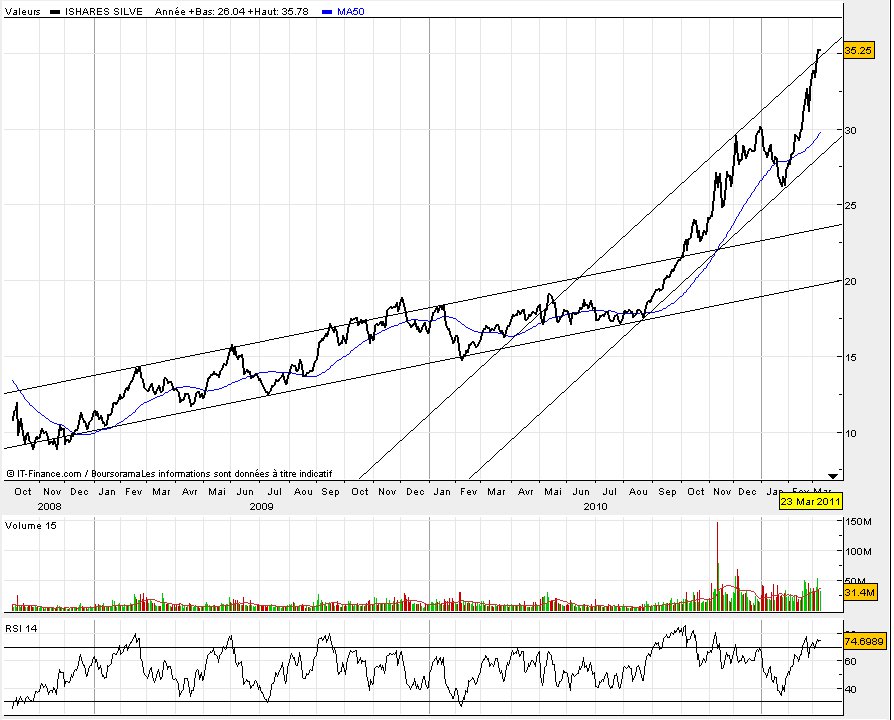
Silver has had quite a run especially since it's breakout last September and is up over 100% since that time. As long as we have negative real interest rates I do not really worry about the long term trend for silver. However, in the short term, silver had just hit to top of its recent ascending channel, the RSI 14 indicates it is oversold, and the RSI14 has not been in an oversold position since February 2010, although it was close to be during January 2011 correction. (See SLV ETF chart below, Source: Boursorama.com).

So unless we are right now in the final stage of silver bull market, we could expect a short term correction of silver to the lower band of the ascending channel close to 30 USD. I